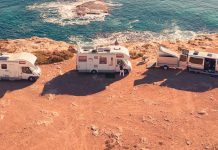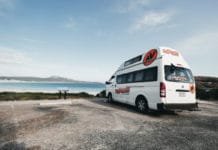















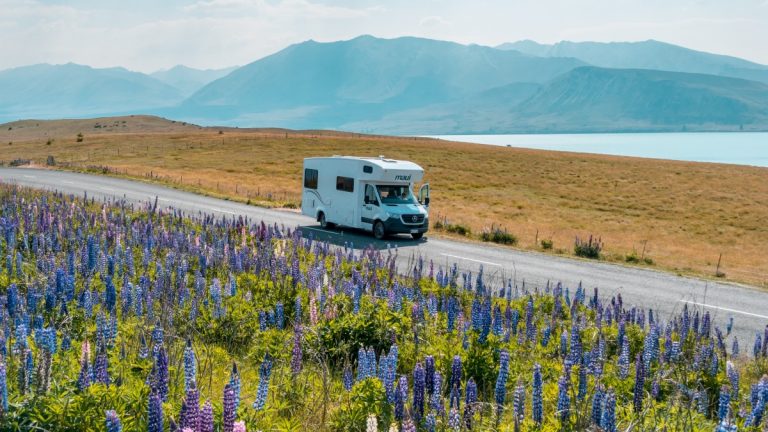
Travelling Australia by motorhome with children is one of the best ways to see the country, you set your own pace, you never have to check in and out of hotels, and the kids get a bed, a kitchen and a bathroom that follow them everywhere. But choosing the right vehicle for a family is not the same exercise as choosing one for a couple. The decisive factors are not comfort and budget: they are seatbelts, child restraint anchor points and bed layout, and getting them wrong can cost you your booking on collection day.
This guide covers what actually matters when picking a family motorhome in Australia, the child seat rules that catch overseas visitors out, 2026 rental prices, and which models suit families of three, four and six.
Table of Contents
The number one constraint: you can only fit two child seats
Australian rental fleets are built so that belted travel seats match the berth count, a 6-berth motorhome such as the Apollo Euro Deluxe has six seatbelts, two in the cab and four in the rear. Seating capacity is rarely the problem.
The problem is child restraint anchor points, and almost every motorhome in Australia has exactly two, whether it is a 4-berth or a 6-berth. Britz, Apollo, Maui and Mighty all cap it at a maximum of two child restraints of any type per vehicle, and that limit does not increase with vehicle size.
The practical consequence is stark: since every child aged 7 and under must be in an approved restraint, a family with three children under 7 cannot legally hire a standard rental motorhome in Australia, no matter how many berths or seatbelts it has. A family of two adults plus two under-7s and one older child is fine. Two adults plus three under-7s is not.
Two further restrictions apply to where those seats can go. Child and booster seats may only be fitted to forward-facing rear seats, never the front passenger seat, never a rear-facing dinette seat. And some models accept only a universal restraint installed with a three-point belt, because they have no top tether anchor or ISOFIX fitting at all.
Before you book anything: confirm in writing how many child restraint anchor points the exact model has, where they are positioned, and which restraint types they accept. Child seats must be pre-booked, they are an extra-cost hire item and cannot be guaranteed on arrival.
Child car seat rules in Australia
This is where most international families get caught, and it is worth reading carefully.
Child seats bought overseas are illegal to use in Australia. Only restraints certified to the Australian/New Zealand Standard AS/NZS 1754 may be used. European ECE R44 and R129 seats, and American FMVSS seats, are not approved — including ISOFIX models. The Australian standard requires a top tether strap, a rebound prevention feature, side impact testing and inverted rollover testing, which the overseas standards do not all cover. Bringing your own seat from home is not an option: you will need to hire an Australian-compliant one from the rental company, or from a specialist baby hire service.
The age-based rules apply nationally:
- Under 6 months — rear-facing restraint with inbuilt harness
- 6 months to 4 years — rear-facing or forward-facing restraint with inbuilt harness
- 4 to 7 years — forward-facing restraint with harness, or a booster with a lap-sash belt
- Under 7 — cannot travel in the front row if the vehicle has two or more rows of seats
Two practical consequences for motorhomes specifically. First, boosters need a lap-sash belt, never a lap-only belt — and lap-only belts are still common on rear dinette seats in older campervans. Second, many campervans have anchor points suitable for a booster but not for a rear-facing capsule, which rules them out for babies and toddlers. Ask about this by model, not by brand.
The driver is legally responsible for every child in the vehicle, and fines and demerit points apply. Full details are on the Queensland Government child restraint page, with equivalent rules in every state.
What else to look for in a family motorhome
Bed layout matters more than bed count
There is a real difference between a vehicle with permanent beds and one where you convert the dinette every single night and rebuild it every morning. With small children who nap, go to bed early, or wake at 5am, a drop-down front bed or a fixed rear bed transforms the trip. A layout that requires dismantling the only table in the vehicle to put a toddler down does not.
Also check whether upper bunks have a safety net or rail. Many do not, which means an adult has to sleep alongside a young child.
Bathroom or no bathroom
For couples, an onboard toilet and shower is a nice-to-have. With children it is close to essential — night-time toilet trips across a dark caravan park, and the ability to rinse sand off before dinner, are worth the extra daily rate. The trade-off is size, cost and the daily chore of emptying the cassette.
Air conditioning, and where it works
Check whether the vehicle has living-area air conditioning or only cab air conditioning, and whether it runs off mains power only. In a Queensland or Northern Territory summer, a unit that only works when plugged into a powered site effectively decides your camping options for you.
Size versus your confidence at the wheel
A 6-berth motorhome is roughly 7.5 metres long and 3 metres high. It will not fit in most supermarket car parks, low-clearance drive-throughs or many national park access roads. Height strikes are one of the most common damage claims. If nobody in the family is comfortable manoeuvring something that size, a 4-berth with a bathroom is a better trip than a 6-berth you dread parking.
How much does a family motorhome cost to rent in 2026?
Motorhome pricing in Australia runs on yield management: rates rise as availability falls. Last-minute bargains barely exist in this market, and in family-sized vehicles they are close to non-existent, because there are far fewer 6-berths in any fleet than 2-berths.
| Season | 4-berth / day | 6-berth / day |
|---|---|---|
| Low (May–August, southern states) | A$110–170 | A$150–230 |
| Mid (March–April, September–November) | A$150–210 | A$200–280 |
| High (December–February, school holidays) | A$210–300 | A$280–420 |
One important caveat: these seasons describe southern Australia. The tropical north inverts them completely. In Cairns, Darwin and Broome, the dry season from May to October is peak, and the wet season from November to April is when rates collapse. If your itinerary is northern, read the calendar the other way around.
Three things reliably bring the price down: booking 3 to 6 months ahead, hiring for more than 14 days (per-day rates drop noticeably at the 14 and 21 day thresholds), and collecting from a major city rather than a regional depot. Competition in Sydney, Melbourne, Brisbane, Adelaide and Perth is far stronger than in Alice Springs, Broome, Airlie Beach or Townsville, where you will pay a premium for thinner availability.
Costs beyond the daily rate
Budget separately for child seat hire (typically A$10–15 per day, capped per rental at some suppliers), a one-way fee if you are not returning to your pick-up city, and family extras that are rarely included: high chair, extra bedding, camping chairs and table, and a portable Wi-Fi hotspot.
Running costs add up quickly in a large vehicle. A 6-berth motorhome uses 14–18 litres per 100 km, and powered caravan park sites run A$45–75 a night for a family — more in coastal Queensland over the holidays, when they also book out months in advance.
Insurance and the bond
Basic third-party cover is included in every rental. Damage to your own vehicle is not. If you decline the supplier’s excess reduction, expect a bond of A$3,500 to A$7,500 blocked on a credit card in the main driver’s name for the entire hire — a significant amount to have frozen while travelling with a family.
Your three options are the rental company’s own excess reduction, a standalone policy, or cover included with a premium credit card. Compare them before you arrive, because the depot counter is the worst place to make this decision. More detail in our guide to motorhome insurance options in Australia and New Zealand.
Compare family motorhome prices
Because family-sized vehicles are the scarcest part of every fleet, comparing across suppliers in one search saves both money and disappointment. Motorhome Republic covers Apollo, Britz, Maui, Mighty, Cheapa Campa, Jucy, Star RV, Camperman, Travellers Autobarn and others.
Rental companies for families
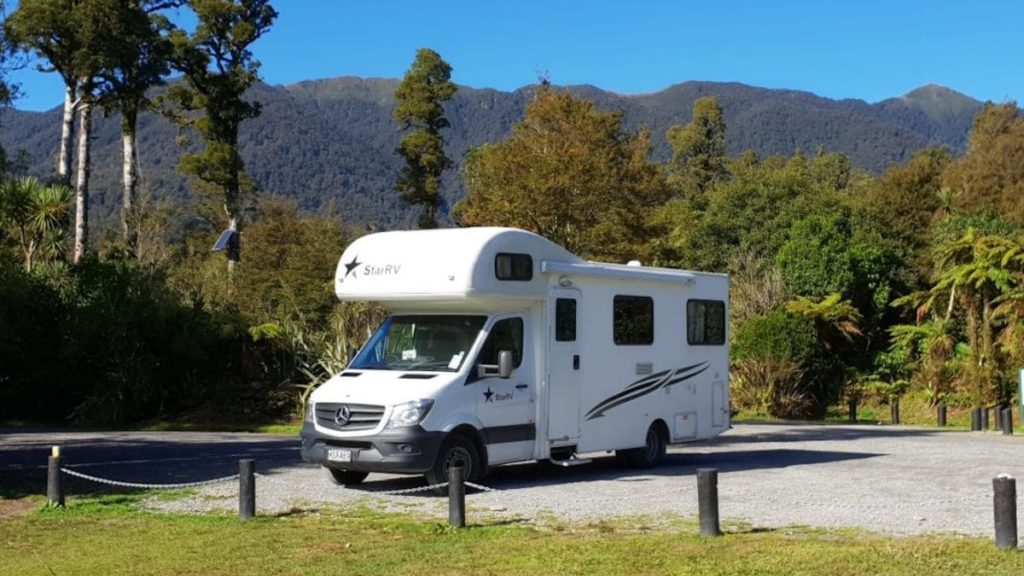
Most of the Australian market now sits under one roof. thl (Tourism Holdings) owns Britz, Maui, Mighty, Apollo and Cheapa Campa following its acquisition of Apollo, and operates a tiered fleet: Maui receives the newest vehicles, Britz and Apollo take them next, and Mighty and Cheapa Campa run the oldest at the lowest prices. For a family, that cascade is genuinely useful — the same floor plan is often available at three price points depending on vehicle age.
- Premium: Maui, Star RV — newest fleets, best-equipped, highest daily rates
- Mid-range: Britz, Apollo, Cruisin Motorhomes — the sweet spot for most families
- Budget: Mighty, Cheapa Campa, Jucy, Travellers Autobarn, Camperman, Spaceships, Awesome Campers — older vehicles, fewer family-friendly layouts, but substantially cheaper
Depots are almost always near the airport rather than in the city centre, so factor in a transfer on collection day. More detail: motorhome and campervan rental companies in Australia.
Best motorhomes for a family of 2 adults and 1 child
Vehicles without a shower/toilet: Campervans
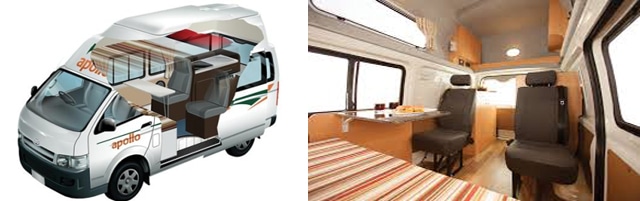
Campervan Apollo: 4 seats
Campervans are great for people that don’t need a lot of comfort, especially when you aren’t travelling for long. With a campervan, you get the basics: a kitchen, table, and two double beds. You will have to use public toilets and showers during your trip.
Vehicles with a shower/toilet: Camper, Motorhome
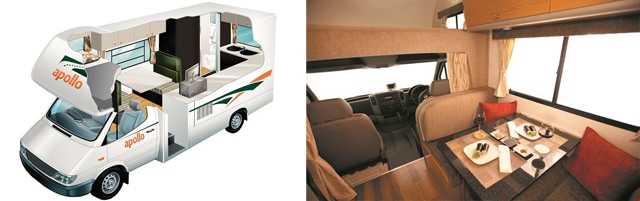
Apollo Euro Camper 4B
OR
2 + 1 Britz Venturer 2 plus
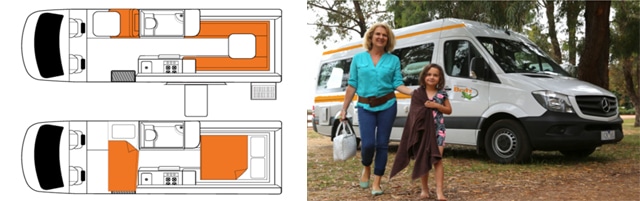
With these vehicles, you can enjoy the flexibility of a motorhome and a minimum of comfort. These models come with a small bathroom with a shower and toilet, a bench that converts into a bed, and a kitchen area. Depending on the model, you can opt for 3 or 4 beds.
Best motorhomes for a family of 2 adults and 2 children
Vehicles without a shower/toilet
Apollo Endeavor
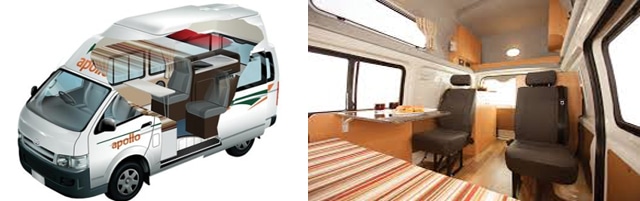
Mighty Double Down
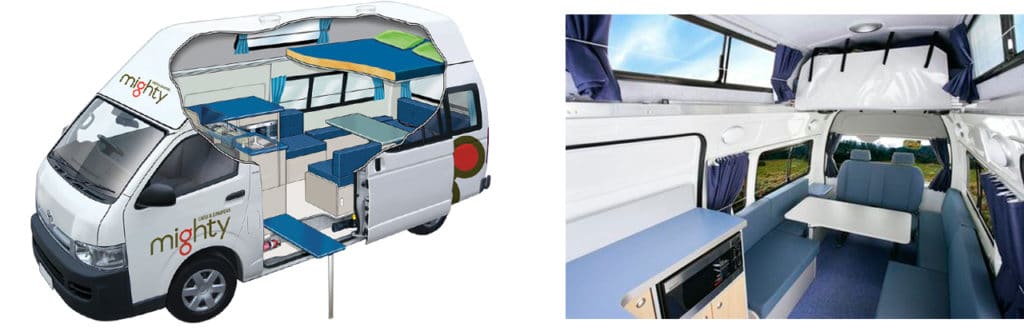
These two models let you install a baby seat or a seat booster (usually for children over 4 years old) at the rear of the vehicle. Note that there is no safety net. So if you are traveling with a toddler or baby, an adult will have to co-sleep with them.
Vehicles with a shower/toilet
Apollo Euro Camper 4B
With this vehicle, you will enjoy the comfort of a shower/toilet. You also have a bench that converts into bed and a kitchen area.
Best motorhomes for a family of 4-6 people
Vehicles without a shower/toilet
Here are a few examples you can opt for:
Camperman Paradise 5
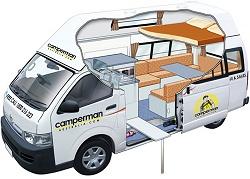
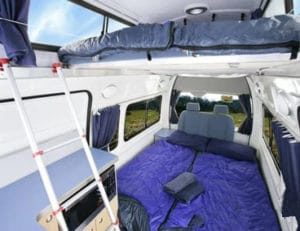
This campervan lets you install two baby seats at the bottom of the vehicle. This is not ideal for very young children, especially if you need to be able to reach them quickly.
Traveler Autobarn High Five 2
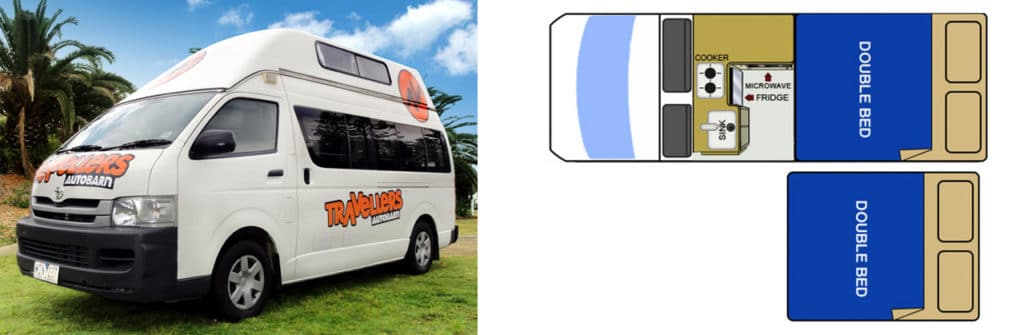
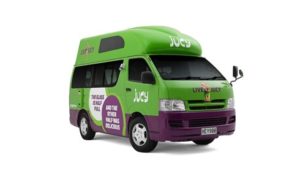
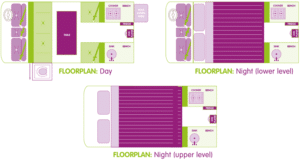
Jucy Condo
Vehicles with a shower/toilet
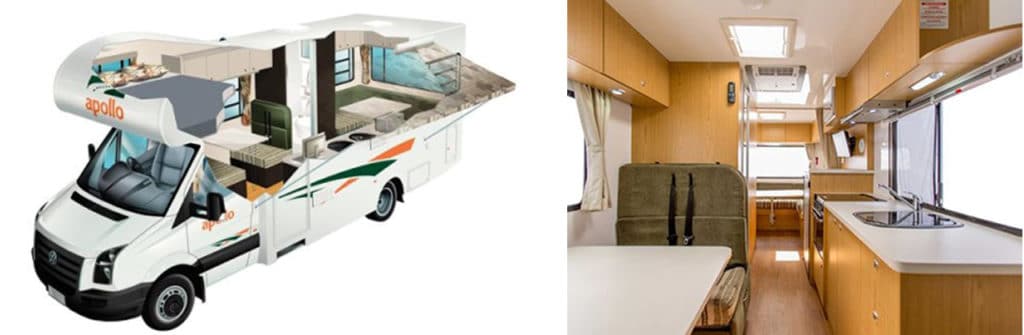
Apollo Euro Deluxe 6B
This model gives you all the comfort and space you need. It is pretty big though, so make sure you’ll be comfortable driving it!
As you can see, there are many different models available for your trip. You can choose the model that suits you best, depending on your situation and your budget.
Best Routes for a Family Motorhome Trip
Sydney to Cairns — 2,500 km, 3 weeks. The classic family run. Short driving days, a beach town every couple of hours, and enough variety to keep children engaged: koala sanctuaries at Port Macquarie, the Whitsundays, the Great Barrier Reef at the top. Entirely sealed and 2WD-friendly.
Perth to Exmouth — 1,250 km, 2 weeks. The Coral Coast. Quieter roads, excellent wildlife, and snorkelling straight off the beach at Ningaloo, which is far easier with young children than a boat trip to the outer Great Barrier Reef.
Adelaide to Darwin — 3,000 km, 3 weeks. The Red Centre via Uluru and Kings Canyon. Spectacular, but long distances between stops and extreme summer heat — best suited to families with older children, and only between May and September.
Tasmania loop — 1,500 km, 10 to 14 days. The most manageable option with small children. Nothing is more than a few hours away, caravan parks are excellent, and the wildlife is genuinely easy to spot. Book the Spirit of Tasmania ferry early and confirm your vehicle is permitted on it.
Whichever route you choose, plan around caravan parks with pools and playgrounds rather than free camps. They cost more, but a fenced play area at the end of a driving day is worth it, and apps like WikiCamps Australia and CamperMate let you filter for them. Book ahead during school holidays — coastal parks fill months in advance.
Frequently asked questions
The best time to travel depends on the regions you plan to visit. For the northern parts, the dry season from May to October offers comfortable weather. For southern Australia, the summer months from December to February are ideal.
Generally, a standard car license is sufficient to drive most motorhomes. However, for larger vehicles over 4.5 tonnes, a Light Rigid (LR) license may be required. Always check the vehicle’s requirements and your home country’s license validity in Australia.
Apps like WikiCamps Australia, CamperMate provide comprehensive listings of campsites and caravan parks, including amenities, prices, and reviews, helping you find family-friendly options.
Yes, Australia has regulations on free camping. While many areas allow it, some places require you to stay in designated campgrounds or caravan parks. Always check local regulations and signs, and consider using apps that identify legal camping locations.