















Planning to explore Australia on your own terms? Renting a vehicle is a great option to discover the country’s best road trips and off-the-beaten-path destinations. Whether you’re travelling solo, as a couple or with friends, here’s everything you need to know before hitting the road in a rental car.
Table of Contents
How to Rent a Cheap Car in Australia?
Three options are available to you for your car rental:
- Book a vehicle via a rental company’s website
- Go directly to a rental agency (if you are already in Australia)
- Use an online comparator like Airport Rentals to get the best price.
When selecting a rental company, consider factors such as rental costs, vehicle selection, insurance options, and customer reviews. Online comparison tools can be invaluable in finding the best deals and ensuring you choose a company that meets your specific needs.
Tips to Save Money
- Book your vehicle in advance
- Avoid “one way” rental (see below)
- Opt for renting agencies located in airports (prices are lower)
- Rent your vehicle for a period of more than 5 or 7 days to get lower rates
- Travel as a group so you can share rental, fuel and repair costs
- If you are traveling with several people, nominate a driver who is at least 21 years old.
Requirements to rent a car in Australia
- Age: Most companies set the minimum at 21. A handful will rent to 18–20 year olds with heavy restrictions and a large surcharge, and some refuse under-25s on larger vehicles and 4WDs. Always check before booking.
- A valid driver’s licence, held for at least 12 months. If it isn’t in English, you need an International Driving Permit or an official NAATI-certified translation, carried alongside your original licence (not instead of it).
- A credit card in the driver’s name for the security bond. Debit cards are frequently refused and prepaid cards almost never accepted.
Licence not in English?
We provide official NAATI-certified translations of foreign driving licences, accepted by rental companies, police and transport authorities across Australia. Handled online — no office visit needed.
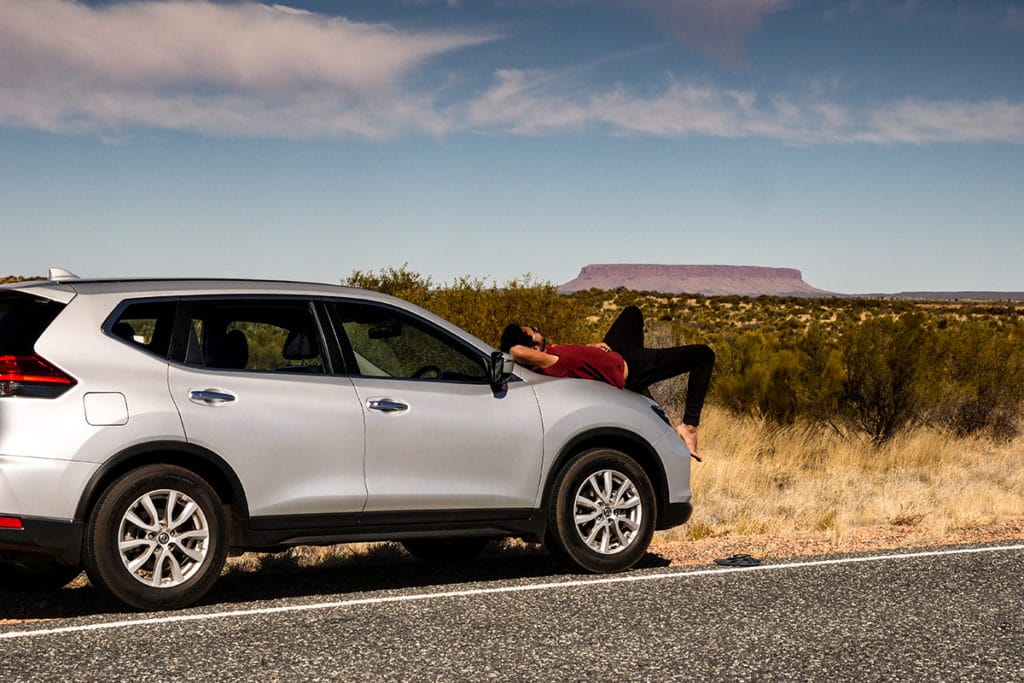
Why Rent a Car in Australia?
- Freedom to explore remote areas
- Flexibility to stop anywhere for views, hikes or photos
- Often cheaper than flights or organised tours for 2+ people
- Combine with camping = big savings on accommodation
It is a great option if you’re travelling the East Coast, Tasmania, or Western Australia where public transport is limited.
What Type of Car to Choose?
Quick overview of vehicle types:
Small car are best for City breaks, couples. They are economical & easy to park.
SUV are great for long drives and remote areas. You will have more space & off-road capability.
Vans are ideal for budget travel + sleep inside as it combine transport + accommodation.
4WD to explore the Outback & national parks. Needed for dirt roads (check terms).
By going to the AirportRentals.com website, you can see all the different models of car that are available. You can choose from a wide range of models (Toyota, Hyundai, Nissan, Mercedes, Suzuki, Ford etc…).
In order to find the car that suits you best, you can adjust your search criteria by selecting: the number of seats (2, 4, 8), the type of car (economy, compact, hybrid, premium) and the transmission (manual or automatic). You can also input your price range. The further in advance you book your rental, the more choice you will have when it comes to the model (and therefore you can find a better deal).
How much does car rental cost in Australia?
Daily rates swing enormously with season, city, vehicle and how far ahead you book. These are realistic bands rather than headline prices — the low end is what budget operators charge out of season, the high end is what you’ll pay walking up to an airport desk in January.
| Vehicle | Budget operators | Major brands | Peak season |
|---|---|---|---|
| Small / economy | $20–35 | $45–70 | $80+ |
| Intermediate / SUV | $40–60 | $65–100 | $120+ |
| Van / campervan | $50–90 | $90–150 | $180+ |
| 4WD | $80–120 | $120–200 | $250+ |
Prices in AUD per day, all-inclusive of mandatory fees, excluding excess reduction and extras. Checked August 2026.
Three things move these numbers more than anything else. Length of hire: the daily rate drops sharply past a week, and a fortnight in an economy car can work out around $250–350 all in. Season: June is consistently the cheapest month, while December to February and the school holidays are the worst. And city: Adelaide is reliably the cheapest capital for hire cars, running roughly a third below the national average, while remote pick-up points like Exmouth or Broome are far dearer.
⛽ Fuel: budget carefully in 2026
The Australian national average for regular unleaded was around $1.75–1.80 per litre in late July 2026 but that figure has been anything but stable. Prices climbed from roughly $1.77 in late February to an all-time record of about $2.53 per litre in early April, driven by Middle East supply disruption and compounded by a refinery fire, before easing back over autumn and then rising again through July.
Remote fuel is a different economy altogether. The gap is what catches out first-time Outback drivers. In April 2026, while Darwin averaged about 209 cents a litre, Alice Springs sat near 272, Katherine near 260 and Tennant Creek near 285, roughly 35% more than the capital, on the same day, in the same territory. On a 3,000 km Outback loop that difference alone runs into hundreds of dollars.
Factors Affecting Car Rental Prices
Extra costs
Many companies charge an extra fee for rentals when the driver is under the age of 21. Some agencies will actually refuse to rent cars to drivers under the age of 21 (sometimes it can be 25). Make sure to check this with the agency before renting.
The rental agency may also ask you to pay extra to rent equipment (GPS type, car seat, etc.).
Mileage
The number of kilometres you can travel with a rental car are not always unlimited. There are two options when renting a car:
- Unlimited Mileage: The price will be the same, whether you drive 100 or 500 kilometres.
- Authorised mileage: You are only allowed to travel a certain number of kilometres during the rental. Additional kilometres traveled will be payable per kilometre. Rates are generally around $0.25 to $0.30/km.
Cancellation fees
If you cancel your rental, the company will keep the deposit you made during your booking process. Sometimes the company also charges an additional penalty if you don’t pick up the car you booked. When it is not the case, you will see the mention ‘Free cancellation’.
Deposit
A deposit is required for any rental. The cost of the deposit depends on the type of car you rent as well as the driver’s age. It is taken out of your credit card and you get a refund when you return the vehicle.
Insurance and excess
Australian rentals include basic third-party cover by law, but you remain liable for damage to the vehicle up to an excess, routinely $3,000 to $8,000 AUD, and higher again for 4WDs and young drivers. That’s the figure that matters, not the daily rate.
You have three ways to reduce it:
- The rental company’s excess reduction, bought at the desk. Simplest, but more expensive, commonly $25–45 AUD per day.
- Excess cover through a comparison site, which is typically a fraction of that price for equivalent protection. You still pay the bond up front and claim back afterwards. By taking out private insurance or the one offered in the airportrentals.com comparator, you will pay much less (around €7/day). On the other hand, you’ll have to pay a deposit in advance, which you will get back at the end of the rental period.
- A standalone car hire excess policy or your travel insurance. Check whether yours includes it, and check the exclusions — many won’t pay out for single-vehicle accidents, unsealed roads, or damage to windscreens, tyres and the underbody, which is precisely what gets damaged in Australia.
Whatever cover you buy, you still pay the bond. Third-party excess insurance reimburses you after the fact — it does not stop the rental company taking the money from your card first. Make sure your credit limit can absorb it.
Roadside assistance is included with most rentals, but not unconditionally: call-outs caused by driver error — wrong fuel, lost keys, a flat battery from lights left on — are usually chargeable, and cover may not extend to roads excluded from your agreement.
⚠️ Unsealed roads: the clause that voids everything
This is the one to read twice. The overwhelming majority of Australian car rental agreements exclude all cover the moment you leave a sealed road. Not reduce it — void it entirely. Drive 200 metres down a gravel track to a lookout, put a stone through the sump, and you can be liable for the full value of the vehicle, plus recovery costs from wherever it stopped.
It catches people constantly, because plenty of Australia’s best spots sit at the end of a few kilometres of dirt. Some standard cars in the Northern Territory and Western Australia are also barred from specific named roads outright.
- Ask explicitly at the desk which roads you may use, and get the answer in writing on the agreement.
- Renting a 4WD doesn’t automatically buy you permission. Many 4WD hires still exclude unsealed roads unless you pay for a specific off-road package.
- Beach driving, floodways and river crossings are almost universally excluded, whatever the vehicle.
- Roadside assistance often won’t come to you on an excluded road, which is how a flat tyre becomes a four-figure recovery bill.
If your itinerary genuinely needs dirt roads, budget for a specialist 4WD operator that permits them rather than hoping nobody checks. Buying your own vehicle is often the better answer for a long trip.
One way car rental
It’s possible to rent a car in one city and return it in another city. In the same way you can with a campervan, you can rent a car in Sydney and return it in Brisbane. You will need to return your vehicle to the agency indicated on your rental agreement.
The price of a one way rental depends on lots of different criteria, mainly on the location where you want to drop off your vehicle. As with a regular car rental, you will be given a date by which you must return the car. You must also provide a deposit which will be returned to you at the agency in your destination city. However, the daily rate increases considerably. We recommend that you compare the cost of deposit in different cities. It might be worth driving an extra hour to get to a more affordable agency.
Pros
Relocation is less expensive than with traditional rental. You will only have to pay for gas.
Cons
The rental period is limited and you have to keep below a certain mileage, so you have less freedom and flexibility in your trip.
Relocation deals
Most car rental agencies offer a relocation service. You will either find a dedicated page on their website or you can contact them directly to find out more information. Companies that offer relocations include Apollo and Wicked Campers.
Where Can I rent a Car in Australia?
You can hire a vehicle almost anywhere in Australia. There are usually rental agencies near airports or in the city centre. You can also go through an agency or your hotel to rent a vehicle.
You will find car rental agencies in major cities and regional towns. However, it is easier to find an agency in a big city, and the rates are lower.
Car rental companies
The main car rental companies in Australia are Avis, Hertz, Europcar, Thrifty and Budget. All of these companies are usually found in city centres (CBD) and near airports. They offer relatively similar services, so price is probably the biggest factor to consider. There are also many smaller players on the market with entry-level offerings. These include, for example: Alpha, East Coast, Apex, Alama, etc.
Pick up and drop off of a vehicle – What to Check?
Picking up your car rental
Start by reading the rental agreement carefully, in order to avoid any unpleasant surprises when returning the vehicle. Look for information on any additional charges, for example.
Before leaving the rental lot, inspect the exterior of the vehicle for any existing damage and ensure it’s noted on the rental agreement to avoid disputes later. You can even take some pictures.
Also check if the equipment works well: the air conditioning, the heating, the windscreen wipers, the headlights etc. You should expect a full tank of fuel. Most rental companies operate a full-to-full fuel policy, meaning you’ll need to return the car with a full tank or face additional charges.
Check that the vehicle matches the selected model. It can sometimes happen that the model you booked is no longer available. In this case, a different model (usually an upgrade) will be offered to you.
Returning Your Rental Car
Upon returning your rental car, ensure it’s in the same condition as when you picked it up and adheres to the company’s fuel policy. Be mindful of the return time specified in your rental agreement to avoid late fees. A final inspection will be conducted to check for any new damage or discrepancies.
Why should I check my rental car?
The number one reason you should always inspect your rental car, before you drive off is that if you discover something is wrong with the vehicle during your trip, you’ll have difficulty proving that you aren’t to blame. Keep in mind that you must pay the rental agency a deposit, which they can keep to cover the damage.
It’s always easier to solve a problem when you’re still in the garage rather than contacting them later. In Australia and New Zealand in particular, distances between different rental locations are usually long. If you discover there is a problem with the vehicle, the rental company will generally ask you to go to their closest rental location to have the problem solved. This could potentially result in you having to take a big detour, and delaying your trip by several days.
Driving in Australia: what’s different
- Australians drive on the left. Obvious until your third day, when you pull out of a quiet car park on autopilot. Left turns are the tight ones. Roundabouts go clockwise, and you give way to the right.
- Speed limits are enforced hard, with fixed and mobile cameras everywhere and no tolerance margin worth relying on. Motorways are generally 100–110 km/h, with some Stuart Highway sections in the Northern Territory at 130. Towns are 50 km/h, school zones 40 or less at posted times.
- Phones. You cannot touch your phone while driving, including at red lights. Queensland is the strictest: it must not be in your hand, on your lap, or touching any part of your body. Fines run into the hundreds.
- Alcohol limit: 0.05. Random breath testing is routine and frequent.
- Wildlife at dawn and dusk. Kangaroos are the single most common cause of vehicle damage outside cities, and animal strikes are frequently excluded from cover. Avoid driving in the two hours around sunrise and sunset outside urban areas.
- Distances are the real hazard. Sydney to Cairns is further than London to Moscow. Plan under 600 km a day, stop every two hours, and never treat a map’s straight line as a quick hop.
- Tolls exist only around Sydney, Melbourne and Brisbane, and are cashless. Ask how your rental handles them — some fit a tag and bill you, others add an administration fee per crossing.
- Fuel runs around $2.00/L on the coast and climbs steeply in remote areas, where roadhouses can charge far more. Fill up whenever you’re below half a tank in the Outback.
FAQs
If your licence is in English then no. Otherwise, yes, you’ll need to show your national licence, along with your international licence. If you don’t have an international licence, you can have your licence translated.
You must be at least 19 years old. Some companies require you to be at least 21. Please check this point before booking.
Yes, in general this is not a problem. Only certain roads (for example, unpaved roads) may be off-limits to you. Make sure you check this with the rental company when you pick up the vehicle.
Updated on 09/08/2026