













Australia is home to world‑ranked universities, cutting‑edge research and a multicultural campus life. Here’s everything international students need to know—from visas and tuition to work rights, living costs and post‑study pathways.
Table of Contents
Which Visa Options to study in Australia?
If you want to study in Australia, you have 3 visa options:
- A Visitor/ Tourist Visa allows you to study for a maximum period of three months (choice of courses: full time, part time …)
- A Working Holiday Visa allows you to study for a maximum of four months (choice of courses: full time, part time …)
- The Student Visa is what you need if the two previous options do not suit you. This visa allows you to study the course of your choice for as long as you wish. It also gives you the right to work during your studies.
Student Visa (subclass 500)
The Student Visa allows you to study:
- Vocational Education and Training (VET) courses –a registered VET course or a registered course for the award of an advanced diploma
- Higher education courses
- English Language Intensive Courses for Overseas Students (ELICOS)
- Postgraduate Research degrees
- Secondary school exchange program.
⚠️ Since 1 July 2024, Visitor visa holders (subclasses 600, 601, 651) are unable to apply for a Student visa while in Australia.
Other students visas for specific situations
- Student Guardian visa (subclass 590): If you want to come to Australia to provide care to a student under 18 years.
- Training and Research visa (subclass 402): For training and research opportunities which allow you to take part in structured workplace-based training.
- Temporary Graduate visa (subclass 485): If you have finished your studies and wish to work in Australia temporarily, you may be eligible for the post-study work visa.

Eligibility & Conditions
Step 1: Enrol in an Australian school / institution
To get your Student Visa you have to be accepted by an Australian institution CRICOS accredited (Commonwealth Register of Institutions and Courses for Overseas Students). The course duration should exceed three months.
The first step is therefore to decide which studies you want to do and at which institution. The choice of city is also important for the choice of institution. This could be a university, a language school or a vocational training centre (TAFE).
If you are not in Australia to apply, check the school’s website. All university websites have a section for international students. This is where you will find the procedure for applying. You will need to attach various documents to your application (passport, transcript of records, diplomas obtained).
Once you have completed your application form, all you have to do is wait for the school to reply. If you receive a letter of acceptance, you will have to reply and pay the first semester’s registration fee. You will then receive the Overseas Student Confirmation of Enrolment (CoE). The number given in this confirmation is required to apply for your student visa (step 2).
Note: You may have to prove your English language proficiency (entry requirements vary according to your level of English, the course you want to study and between the institutions). It is therefore necessary to register for a session in advance and to prepare for it.
Step 2: Apply for your Student Visa
Once you have obtained your COE (Confirmation of Enrolment) from your chosen Australian institution, you can apply for your student visa.
To apply for a student visa, you need to do it online on the Australian Immigration website.
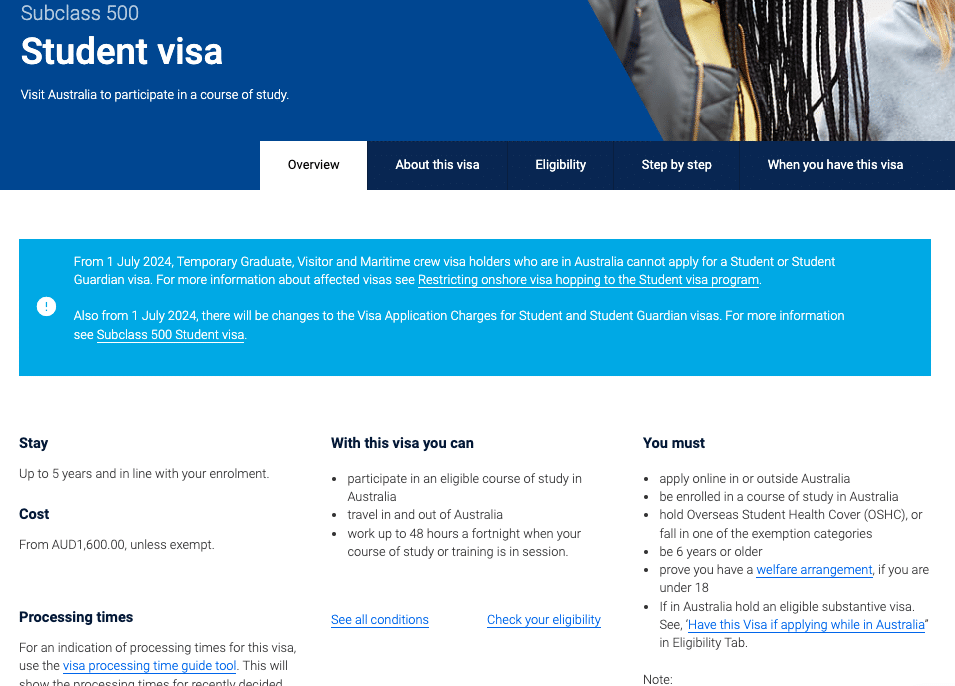
Select the Subclass 500 Visa and complete the application form (approximately 30 minutes).
You will need to attach documents (passport, English test results (if applicable), translated transcripts (if not in English)). Prepare these documents before you start your application. Once the application is finalised, you will receive a Transaction Reference Number to track the progress of your application.
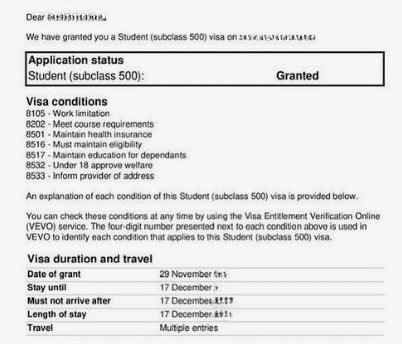
When your application is successful, you will receive a Notification of Grant Letter by email. Don’t delete it. It is your official visa.
Please note that you must have OSHC (Overseas Student Health Cover) for the duration of your studies.
⚠️ 2025 Policy Updates
- International Student Cap: Education Minister can cap new enrollments from 2025 under new legislation—monitor your institution’s intake limits.
- Tighter Financial & English Requirements: to ensure genuine applicants and maintain education quality.

How much does the Student Visa cost?
- Application fee: A$1,600 (doubled from A$710 as of 1 July 2024)
- Processing time: median ~ 13 days (Dec 2024)
- Valid for up to 5 years and in line with your enrolment.
- You can enter Australia up to 90 days before the start of your course.
Do you need some advise to study in Australia ?
You may be unsure about which visa you need, which steps to take, which school to choose or even which direction to take. It’s easy to get lost…
But don’t panic, there are specialist organisations that can help. Such is the case with Study Connection, which will help you free of charge with all the formalities involved in studying in Australia. The costs are borne by the schools. And you don’t need to have a clear plan, they’re there to listen and advise you!!
What does a student visa allow?
The subclass 500 allows you to stay in Australia to study full-time in a recognised education institution. You have to study for a minimum period of three months (full time course). The advantage of the Student Visa is that it allows you to work 48 hours per fortnight (two-week period) during your course and without limitation during holidays. It is a good way to finance your studies or simply to put money aside.
You can study the course of your choice, at the university or school you choose. During your visa period, you can enter and leave the country as you wish. So you can decide to travel to other countries during your holidays!
If you have a partner and if you can proof that you’re in a relationship for more than 1 year, your partner can join your Student Visa for free and work part-time without having to study (same for family members). There is an additional cost to add an applicant on your visa. And apply online in or outside Australia.

How does studying in Australia work?
In Australia, students start their academic year either in February or in July for universities and vocational schools. As far as language courses are concerned, they start every two months or so.
The Australian education system is relaxed and the teachers are accessible. You can easily ask them questions or chat with them after class. Teachers encourage students to participate in debates and discussions during class.
As far as timetables are concerned, in Australia, students generally study four subjects per semester, which represents about ten hours of classes per week. However, you should know that personal work is important.
These light schedules allow students to have a job to finance their studies. Indeed, you can work 48 hours/2 weeks outside the school holidays.
How much does it cost to study in Australia?
Tuition fees
Studying in Australia comes at a price. Australian universities are world-renowned and studying there represents a real investment. In addition to the cost of student life, tuition fees at Australian universities are very high.
| Level | Cost (A$) / year |
|---|---|
| Bachelor’s degree | A$20,000 – 50,000 |
| Master’s degree | A$22,000 – 54,000 |
| Doctorate (PhD) | A$20,000 – 42,000 |
If you want to do a vocational course (TAFE), the fees will be around $10,000 per academic year (less for some courses).
Finally, for language courses, marketing or business schools, the fees are lower, at around $2,000 per term.
Visa application fees
The school or university registration fee does not include the visa fee. So, in addition to the amount you pay at the time of enrolment, you will also have to pay the student visa application fee, from $1600 (July 2024).
Health insurance costs
To study in Australia, you must have health insurance for the duration of your student visa. This insurance, called Overseas Student Health Cover, is compulsory and costs around $400 per year. It provides you with the minimum level of health cover in Australia. It is therefore also advisable to take out student insurance for optimum health cover.
Read also : International Health Insurance for student
Cost of Living
| Expense | Weekly Cost (A$) |
|---|---|
| Shared rent (1 bed) | 250–350 |
| Groceries & utilities | 100–150 |
| Transport (student cap) | 20–40 |
| Mobile & internet | 10–20 |
| Entertainment & misc. | 50–80 |
Expect A$700–1,000/week in Sydney/Melbourne; regional cities can be ~ 15% cheaper.
Which city should I choose to study in Australia?
This will depend on a number of criteria, not least the course you want to follow. The majority of students go to the big cities with the most prestigious universities. The main ones are :
Sydney
Sydney, the country’s iconic city, is home to over 200,000 students. It is a cosmopolitan and very dynamic international city. It has 8 universities:
- University of Sydney
- University of New South Wales
- Macquarie University
- University of Technology (UTS)
- Australian Catholic University
- University of Western Sydney
- University of Notre Dame Australia
- South Sydney : University of Wollongong
Melbourne
Melbourne is the country’s second-largest city. It is renowned for the quality of its universities, which are among the most prestigious in the country. The 7 faculties located in Melbourne :
- University of Melbourne
- Monash University
- Federation University
- Deakin University
- La Trobe University
- RMIT University
- University of Victoria
Brisbane
The city, located in the state of Queensland, is home to 7 universities:
- James Cook University
- Griffith University
- Queensland University of Technology
- USC Australia
- Bond University
- Southern Cross University
- Australian Catholic University
Why study in Australia?
Australia is a country offering an exceptional lifestyle with sunshine, dream beaches and good humour. What’s more, the country’s education system is one of the best in the world. The quality of its education is recognised worldwide with Top‑Tier Institutions: 8 universities in the global top 100 (QS 2025). This will offer you many professional opportunities. Studying in Australia also gives you the chance to move abroad afterwards. Employers will appreciate the fact that you have studied in the country, proving your level of English and local knowledge.
Studying in Australia is also an excellent way of improving your English if it is not your mother tongue. You’ll meet lots of young people your own age from many different countries. During your school holidays, you can take the opportunity to travel and discover this magnificent country.
Post‑Study Work Options
Temporary Graduate Visa (Subclass 485)
- Graduate Work Stream: 18 months for in‑demand fields
- Post‑Study Work Stream: 2–4 years (Bachelor → 2 yrs; Master → 3 yrs; PhD → 4 yrs) The University of Sydney
Skilled Migration
Leverage Australian work experience and the Skilled Occupation List to apply for visas like subclass 189, 190 or 491.
FAQs
The best universities in Australia include the University of Sydney, the University of Melbourne, the Australian National University (ANU) and many others. Your choice will depend on your field of study.
Accommodation options include halls of residence, shared accommodation and private flat rental. Universities often offer advice on accommodation. We invite you to read our dedicated article: Student accommodation in Australia.
Conditions vary from university to university but generally include academic requirements, language test scores and potentially letters of recommendation.
Do you need more help?
For more information about studying in Australia you can visit the official Australian government site for international studies:
- Australian government site for international studies (UK)
- Australian government site for international studies (USA)
Updated 21.04.2025