

















Thinking about studying in Australia? It’s an exciting time to think about going to a university here in Australia. And there’s no doubt that Australian National University (ANU), located in Canberra, is one of the top choices that you should opt for. Aside from its current rank, ANU has stood by its reputation as one of the world’s top-tier universities. Here are some key aspects about ANU.
Table of Contents
Still a global top‑30 uni
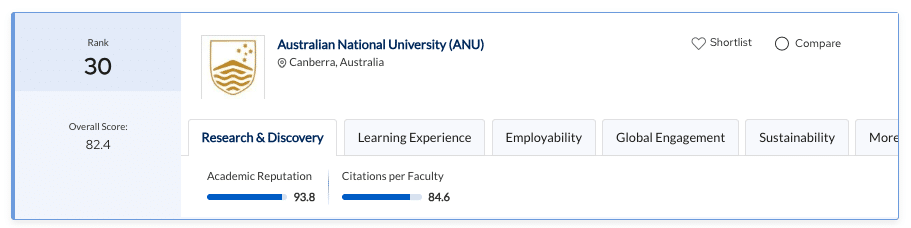
ANU is considered a leading university globally. Highest ranked in Australia’s capital and 4th nationally. It is ranked as the #30 university in the world. Ranked #1 in Australia for graduate employability in the Times Higher Education Global University Employability.
Source: 2025 QS World University Rankings.
Programs Offered
ANU provides a wide range of undergraduate and postgraduate programs. Students can choose from single degrees or flexible double degree options in areas such as Arts, Business and Commerce, Health, Medicine, Psychology, Engineering, and Environmental Sciences. The university is particularly known for its research-driven curriculum and offers significant opportunities for hands-on learning, internships, and exchange programs.
Additionally, as an ANU student, you can connect with industry and government executives through internships and participate in world-class international student exchange programs. You can also join in cultural, sports, and social activities that foster lifelong friendships and networks that enhance your career.
Campus and Community
ANU is located in the heart of Canberra, making it a vibrant place for academic and extracurricular activities. The campus is known for its sustainability, being rated as the most sustainable city in Australia, and it’s considered the third smartest city in the world. There is approx. 17,000+ students (≈35 % international) study across seven teaching colleges.
The campus facilities include a wide range of teaching facilities, modern laboratories, five libraries, medical facilities, sporting fields, food carts/vans, cafes, and a gym. The university area is small and calm with hills, mountains, and bush surrounding it. The Acton campus spans 145 ha with 10,000 trees and over 140 native animal species – including resident platypus in Sullivans Creek. Walking to class you might spot kangaroos, wombats or sulphur‑crested cockatoos – the campus is a registered 146‑ha wildlife corridor for Box‑Gum woodland species.
The university offers a top-tier research-oriented environment. Students can take advantage of world-class facilities, including labs and conference rooms equipped with the latest technology. There are also three main libraries, with more than two million traditional and two million references are housed in electronic volumes.

Tuition Fees and Funding
The cost of studying at ANU can vary widely depending on the program and the student’s residency status. For international students, the indicative fees range from approximately AUD 33,000 to AUD 70,000 per year. Scholarships and financial aid are available to help mitigate these costs.
With 50 individual degrees to choose from, ANU offers the flexibility to design your dual degree from among 750 possible options so that you can tailor your studies to your strengths, passions, and goals.
The ANU offers several courses and programs leading to officially recognized higher education degrees. Among them bachelor degrees (certificates, diplomas), master degrees, and doctorate degrees in several study areas. With the high-tuition cost in the University, the ANU has offered international students scholarships with online research tools to enable prospective students to choose and identify scholarships relevant to their current situation. Scholarships: More than 400 awards worth A$25 m are offered each year.
💸 10% Discount on your Insurance Policy
Find here all the information you need and get your 10% Go walkabout promo code for any policy.
Nobel Laureates and Notable Alumni
ANU counts 6 Nobel Prize winners among alumni and staff, plus 49 Rhodes Scholars. It has also educated two Australian prime ministers and numerous heads of government departments, indicating its role as a significant contributor to public policy and leadership in the region. Governor‑General Sam Mostyn (appointed 2024) is an ANU alumna – one of many leaders in politics, diplomacy and science to graduate from the university.

Other important facts about ANU – To keep you on track!
The School of Cybernetics, launched in 2021, is the only one of its kind in the Southern Hemisphere and offers the world‑first Master of Applied Cybernetics (cybernetics.anu.edu.au).
Thanks to the ACT’s green grid, ANU’s Canberra campuses have sourced 100 % renewable electricity since 2020.
ANU is Australia’s sole member of the elite International Alliance of Research Universities (IARU), alongside Oxford, Yale and ETH Zurich.
Plan your Working Holiday in Australia 📖 Free eBook

Plan your trip in Australia with this free 60-page ebook written by former backpackers who have traveled the length and breadth of Australia.
Inside, you’ll discover everything you need to plan your journey. This ebook will guides you through the entire process, from applying for your visa to booking your flights and understanding the administrative procedures upon arrival.
With detailed insights and practical advice, you’ll navigate each step of your journey with ease. So, get ready to embark on your Australian adventure fully equipped and informed!