














Travelling around Australia in a campervan or motorhome is one of the best ways to explore the country. Renting a vehicle in Australia gives you the freedom to travel at your own pace, save on accommodation, and enjoy an unforgettable adventure. However, rental costs can vary a lot depending on the season, location, and rental company. In this guide, we’ll cover everything you need to know about renting a motorhome in Australia.
Table of Contents
Average Motorhome Rental Prices in Australia
Motorhome rates move with availability and season. Booking three months ahead can genuinely halve what you pay compared with booking a week before departure, because pricing runs on yield management: rates climb as the fleet fills up. Last-minute bargains are rare, and almost non-existent in the larger family-sized vehicles.
As a rough guide for 2026, a basic 2-berth campervan starts around A$70–110 per day in low season and reaches A$150–220 in peak. A full-size 6-berth motorhome runs about A$160–240 in low season, rising to A$300–420 at peak.
Careful with “high season”, it flips depending on where you go. In the southern states, peak is December to February and the cheapest months are June to August. In the tropical north (Cairns, Darwin, Broome), it is the exact opposite: the dry season from May to October is peak, and the November to April wet season is when rates collapse. Check the calendar for your actual route, not for Australia as a whole.
👍 Pro tip: daily rates drop noticeably at the 14-day and 21-day thresholds. If you are hesitating between 12 and 15 days, the longer hire is sometimes cheaper in total.
More information: Motorhome rental prices Australia
Practical Tips for Renting a Motorhome in Australia
Here is what you should know about how to rent a cheap motorhome:
- Book early: The sooner you book, the better the price . Prices rise sharply closer to departure dates , especially around Australian school holidays and summer.
- Plan your itinerary and pickup location: major cities (Sydney, Melbourne, Brisbane, Perth, Adelaide, Darwin, Cairns) offer more vehicles and better rates. Remote depots mean higher prices and thinner choice. One-way rentals usually attract a drop-off fee of A$250 to A$800 depending on the distance — occasionally waived or heavily discounted in low season, when suppliers need vehicles repositioned anyway.
- Check the road restrictions: 2WD campervans and motorhomes are contractually banned from unsealed roads, with a usual exception for well-maintained access roads under about 12 km leading to a recognised campground or attraction. Driving where you shouldn’t voids your cover completely, leaving you liable for the full value of the vehicle. Islands, beaches and named tracks (Gibb River Road, Cape York, K’gari) are excluded outright by most suppliers.
- Understand insurance: A basic insurance is included, but has a high excess (A$2,500–7,500) . You can buy full coverage to reduce your liability, or use third-party rental insurance if available.
- Inspect the vehicle thoroughly: Before driving off, check the inside and outside of the vehicle for damages , test all systems (fridge, water pump, lights), and take photos of any damage.
🚐 5% Discount with Travellers Autobarn
Travellers Autobarn is offering a 5% discount to Australia Backpackers Guide readers with promo code GUIDEEN
Where to Rent a Motorhome in Australia / NZ
Most travellers start their campervan trip from major hubs like Sydney, Melbourne, Brisbane, Perth, Cairns, or Darwin.
Renting in big cities usually gives you:
- Lower rental prices (more competition),
- More available vehicles,
- Easier logistics for pickup/drop-off.
Remote locations (like Alice Springs or Broome) often come with limited availability and higher rental rates. To avoid hefty one-way fees, consider returning your vehicle to the same depot. If you plan a one-way road trip, make sure to compare offers and confirm the exact fees .
Motorhome companies are usually located in proximity to the airport. On the one hand, this location might not be ideal for travellers who where expecting to pick up a vehicle in the city, on the other hand, it is quite convenient for international travellers. In any case, you still need to grab a taxi or shuttle to get to the depot.
More information:
Recommended motorhome rental companies
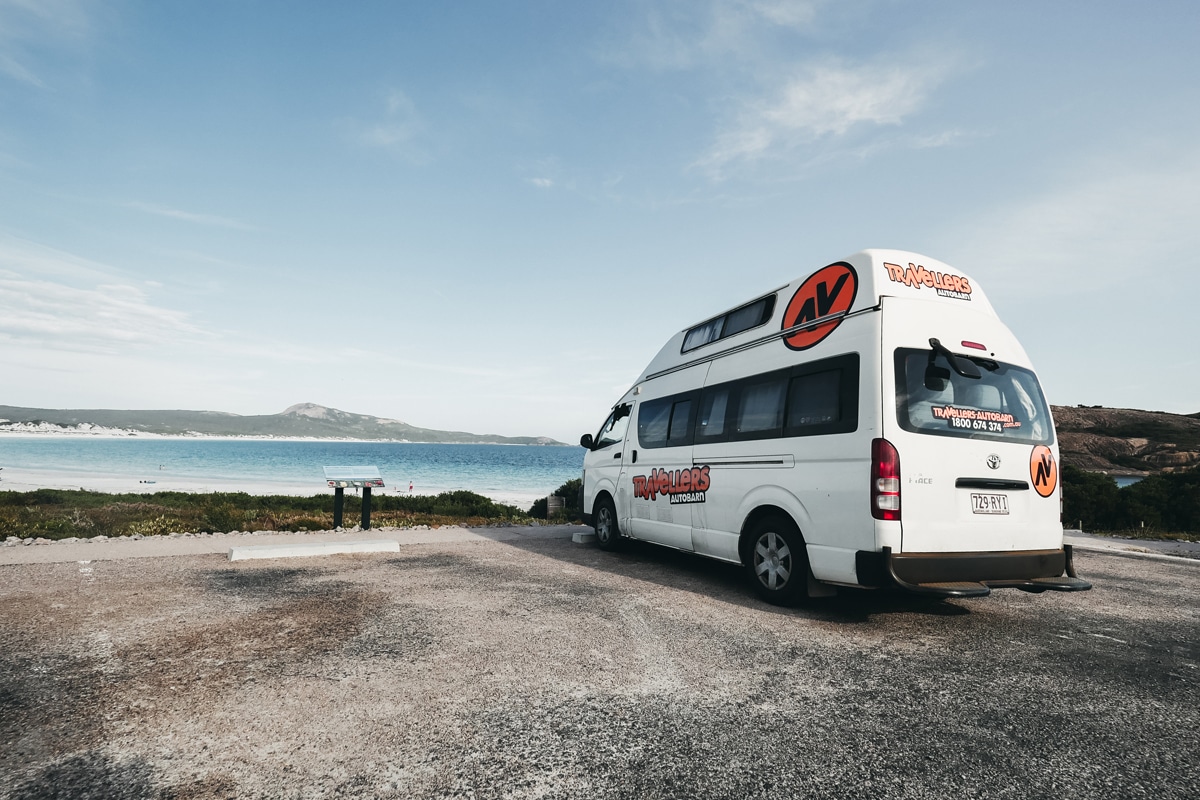
There are over 50 motorhome and campervan agencies in Australia, but the market is far more concentrated than it looks. thl (Tourism Holdings) now owns Britz, Maui, Mighty, Apollo and Cheapa Campa following its acquisition of Apollo, making it the largest RV rental operator in the world. These brands share depots and infrastructure, and operate a tiered fleet: Maui gets the newest vehicles, Britz and Apollo take them next, and Mighty and Cheapa Campa run the oldest at the lowest prices.
That cascade is genuinely useful to know — the same floor plan is often available at three different price points depending only on vehicle age.
Premium and mid-range brands
Maui and Star RV at the top end; Britz, Apollo and Cruisin Motorhomes in the mid-range, which is the sweet spot for most travellers.
Budget brands
Mighty, Cheapa Campa, Travellers Autobarn, Jucy, Spaceships, Camperman, Awesome Campers and Calypso. Older vehicles and fewer inclusions, but substantially cheaper — and several of these (Travellers Autobarn, Jucy, Spaceships, Camperman) rent to drivers from 18, where most suppliers set the minimum at 21.
Note: Hippie Camper has been closed by thl in favour of Mighty, and Kea is no longer offered in Australia. Fleets and brand line-ups shift each season, so confirm at booking.
Find more details on Motorhome & Campervan hire companies in Australia
Motorhome hire in New Zealand
Hiring a motorhome in New Zealand is without a doubt the best way to discover this beautiful country!! It allows you to save money on accommodation and offers you freedom when it comes to seeing the lesser known areas of the islands. Most rental companies you know from Australia operate in New Zealand as well, mainly in Auckland and Christchurch.
More information: Motorhome & Campervan hire in New Zealand
Which City to Start Your Road Trip From?
The city where you rent your campervan or van will determine your road trip in Australia. So make sure to plan your itinerary in advance, taking into account the seasons, points of interest, length of stay, etc. and what you don’t want to miss out in the country.
Some examples:
- Sydney to Cairns: Explore the beautiful East Coast beaches and the Great Barrier Reef.
- Melbourne to Adelaide: Enjoy the Great Ocean Road and the wine regions.
- Perth to Broome: Discover the wild West Coast and remote national parks.
- Darwin to Cairns: An adventure through the Outback and tropical North.
Check out the road trip itineraries in Australia to get an idea of your travel options. This will also guide your choices on the must-see places you absolutely want to discover Down Under.
Types of Motorhomes Available
| Vehicle type | Sleeps | Price / day | Best for |
|---|---|---|---|
| Campervan, 2-berth (no bathroom) | 2 | A$70–220 | Budget couples, easy to drive and park |
| Motorhome, 2-berth (shower & toilet) | 2 | A$110–280 | Couples wanting self-containment |
| Motorhome, 4-berth | 4 | A$120–320 | Families of four, two couples |
| Motorhome, 6-berth | 6 | A$160–420 | Large families and groups |
| 4WD camper, 2 to 5-berth | 2–5 | A$150–320 | Unsealed roads and the Outback |
Ranges span low to high season. 4WD campers usually carry a daily kilometre cap of around 300 km instead of unlimited kilometres.
2 seater motorhomes
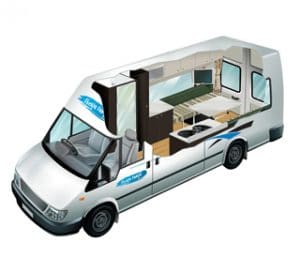
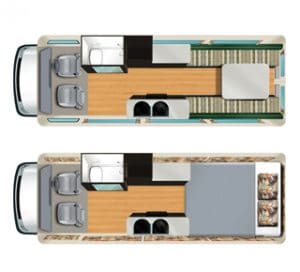
2-seater motorhomes (with toilet & shower) are usually made from the same manufacturer (Ford Transit, Mercedes Sprinter, Volkswagen Crafter). They all have pretty much the same layout, with a double bed at the back convertible into a sofa + table, and a kitchenette at the front with the shower cabin behind the driver’s seat.
3 seater motorhomes
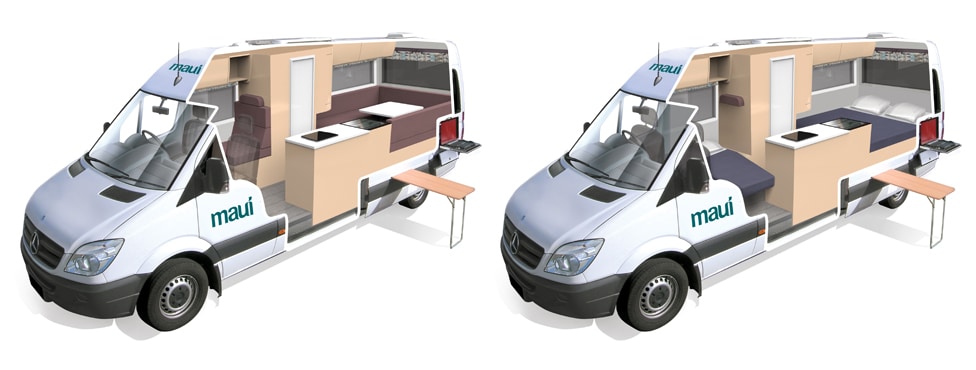
As this model is not much bigger than the 2-seater, it can only accommodate a couple with a young child. 3-seaters are not really common. So you won’t gain any living space. Be aware that 3-seater campervans are not very common and are usually in the “premium” ranges.
4 seater motorhomes
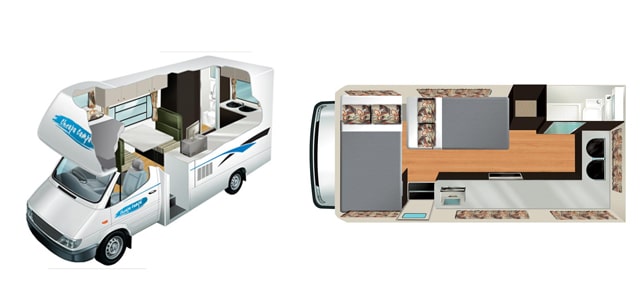
The 4-seater comes with two double beds and is ideal for a family with two children or two couples. However, it might be too small for a group of 4 friends. A large double bed is usually located at the front of the vehicle, convertible into a dining area. At the top, over the driver’s cabin, a second bed is set up. At the back of the vehicle, you have a kitchen area and shower/toilet cabin.
5 seater motorhomes
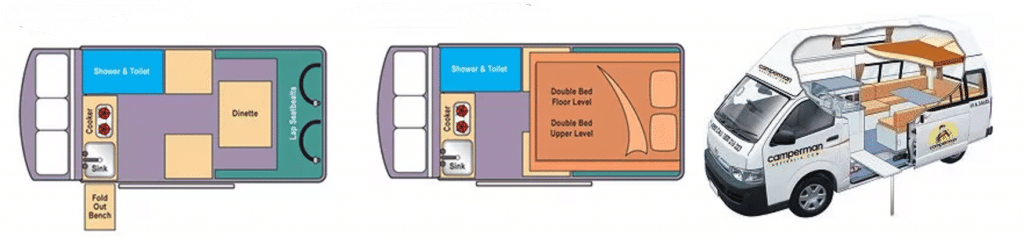
Those models are not really common. Although some companies such as Camperman offer 5 seater motorhomes, none of them have 3 beds. They only have 2 large beds and might not fit everyone.
6-berth motorhomes
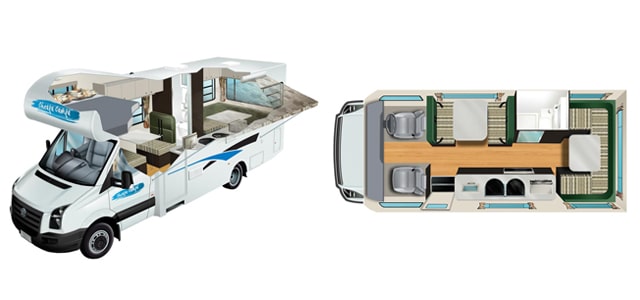
The largest vehicle in most fleets, with three double beds and six belted seats — two in the cab, four in the rear. It genuinely sleeps six, but many travellers book one for four people specifically so they can leave the third bed permanently made up and keep the dining area intact, instead of dismantling a bed every morning.
Bear in mind the size: roughly 7.5 m long and 3 m high. It will not fit in most supermarket car parks or under low-clearance awnings, and roof strikes are among the most common damage claims. If you are travelling with children, note also that a maximum of two child restraints can be fitted to any rental motorhome, including 6-berths — see our guide to the best family motorhomes in Australia.
What’s Included in Your Motorhome Rental?
Most rental packages include:
- Kitchen gear (pots, pans, utensils, crockery),
- Bedding and linen (sheets, pillows, duvets),
- Basic cleaning supplies (broom, dustpan),
- A gas bottle (for cooking), it should be full when you pick up the vehicle,
- 24/7 roadside assistance.
Optional extras (usually paid) can include GPS, outdoor camping furniture (chairs & table), child seats, additional insurance coverage, and more.
More information: Motorhome Insurance options in Australia & NZ
Always read the fine print and choose your extras based on your real needs to avoid unnecessary costs.
Traveling with a campervan: how does it work?
The driving of the vehicle itself, as a big campervan drives differently from a small car. You get used to it relatively quickly and they are also quite manageable. Just be sure to always check your mirrors and use the rear camera if present. Also don’t forget the high of the vehicle for bridges (usually noted at the front of the vehicle)…
Understand is the battery system and take some time during the vehicle inspection for someone to explain everything in detail. Don’t hesitate to take notes as it often involves a lot of information at once.
Another important point is the management of water, clean and used, as well as toilets. You will therefore have 2 water tanks (one clean, one used) and will need to regularly check them. Toilets also have a separate tank that you will need to empty in “dump points” (specific dumping areas that you will find in campsites, service stations or near information centres).
What to check for when renting / returning a motorhome
General check
Here are the important items to check before taking the vehicle:
- Carefully inspect your motorhome for damages before you sign the contract (interior, cockpit, engine etc.).
- Check your dashboard lights and rear view camera (very important for manoeuvring a large camper in tight spaces). Turn on the ignition and spend a few minutes making such everything is working.
- Have a close look at your rental contract including the fine print (look for hidden fees).
- Take photos, especially of existing scratches and small damages on the exterior and interior.
- Double-check that the vehicle corresponds to the model you booked. It can happen that the model you booked is no longer available. In this case, you get a different model. If this happens, you should be upgraded.
- Ask for user directions (electrics, shower, toilet, bed, charging systems etc.). Make sure you know how everything works.
- If you’re planning on driving in Sydney, Melbourne, or Brisbane, get maps and find out about the toll procedure.
Check the equipments of the vehicle
Benches and beds
In motorhomes, most benches convert into beds. Test them to see if everything works. If you find out the first night that your bed doesn’t fit properly, you won’t be very happy. If you have a bunk bed and are travelling with children, you should also check the safety net.
Doors
In motorhomes, there is a side door allowing you to access the inside of the vehicle without having to go through the cockpit. Remember to check that this door opens and especially that the bar to keep the door open is in good condition. People often break this bar by accident. Also test the small step that unfolds at the door. And don’t forget to close it before heading back!
Gas
Check the gas bottles. Normally you will be given one big or two small bottles of gas before your departure. If this is not the case, let the rental agent know immediately. Otherwise you will have to fill them up at your expense!
Shower and toilet
Look at the general state of the bathroom and check the joints around the toilet. If they are too battered and tight, you won’t be able to use the toilet. Also make sure that the water drain works well because the cabin is small and can quickly overflow.
Electrical equipment
You won’t be able to check these features when picking up the vehicle, because it will have to be plugged in. It’s best to test them on your first night though, when you’re not too far away from the rental agency if you need to go back.
How to make a complaint about a rental vehicle?
Before leaving
If you haven’t yet left the rental agency and you spot a problem with your vehicle, you are obviously in the best position as you can show them on the spot what the issue is. But keep in mind that they don’t necessarily have to replace or repair it! Rental agents generally do their best to meet your expectations, but sometimes there are limitations. First of all, they often won’t have another vehicle available. Secondly, some things may take too long to repair. In some cases, they will suggest you wait for a few days (at their expense) until the repairs are done.
During your stay
If you notice a problem during your trip, you must inform the rental company immediately. Never take the initiative to fix things yourself or have your vehicle repaired somewhere without authorisation. Over the phone, a rental agent will be able to guide you to try to rectify the problem. If this is not possible, they will refer you to a mechanic or send you to a store. If the issue is with the vehicle’s equipment, they will usually ask you to drive to the nearest rental depot. So it’s up to you to decide if it’s really worth it.
When returning the vehicle
Obviously, you should avoid waiting until you are returning the vehicle to report a technical problem or defect. If you do this, it’s hard for the rental agent to know if the problem is your fault or not. Then again, it is quite common to notice wear and tear and dysfunctions that won’t be held against you. So don’t worry if you notice that a seal is leaking or a cupboard doesn’t close properly!
Compare motorhome prices
Driving Tips for Australia
In Australia (and New Zealand), the roads are well maintained and you will not have any problem driving with a campervan! Don’t forget that Australia is the country of road trips! However, it is important to keep in mind a few tips that will be useful once on the road:
- Drive on the left-hand side of the road.
- Speed limits are well indicated. The maximum speed on the highway is 110 km/h, 130 on some portions of the Stuart Highway that runs through the country from north to south. In the city, the speed limit is 50 km/h. Around schools and during school hours, the speed limit is 40 km/h, sometimes less.
- You cannot use your phone while driving.
- The 0.05% blood alcohol limit applies to full licence holders only. Learner and provisional drivers must be at zero, and so must anyone driving a vehicle over 4.5 tonnes.
- Highways do not have tolls and are free. The only exception is the major cities such as Sydney, Brisbane, and Melbourne.
- Avoid driving at dawn, dusk and after dark outside towns. Kangaroos and wallabies are most active then, and animal strikes are a leading cause of rental vehicle damage. Many rental agreements formally discourage or prohibit night driving in remote areas.
- Never drive through floodwater. Flood damage is excluded from cover regardless of which insurance option you took.
Related topics:
Article updated on 20.08.2026