















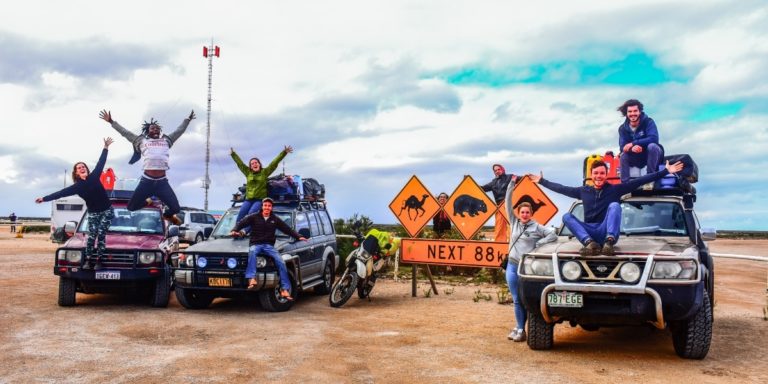
Whether you’re alone or with a group of friends, Ridesharing or Carpooling in Australia is always a good idea to get around. Remember, it is a huge country, so a vehicle is necessary to get from one point to another – no matter if you want to travel between cities, doing a road trip or looking for a farm job, car sharing will probably be the most practical and economical way. This involves individuals offering seats in their cars to others, fostering companionship, reducing travel costs, and promoting environmental sustainability. This article delves into the concept of ridesharing between people, its benefits, and how it enhances the travel experience.
Table of Contents
The concept of People-to-People ridesharing
People-to-people ridesharing, also known as carpooling, is when drivers offer available seats in their vehicles to others who are traveling in the same direction. This arrangement can be organized informally among friends or through community notice boards and dedicated ridesharing websites.
In Australia, this form of ridesharing has been a long-standing practice, particularly in regional areas where public transport options are limited. It provides a practical solution for commuting to work, attending events, or traveling long distances.
Why Ridesharing in Australia?
City to city
Many travelers choose to carpool… often these people will not have a driver’s license or will not have the means or the desire to buy a vehicle. In this case, ridesharing is a very good way to reach a big Australian city. You won’t have many difficulties to find ads and the principle will be much nicer than the bus (very long) or the plane because at least you will be able to enjoy the scenery and meet people! If you don’t have a car, carpooling will be the ideal option!
What should you actually pay?
There’s no fixed rate, and that’s a common source of awkwardness. The convention in Australia is simple: passengers cover a share of the fuel, not a fare. The driver isn’t running a taxi, they were making the trip anyway.
A workable rule of thumb is to split the fuel cost by the number of people in the car. On a long run, work it out before you leave: a car using 8 L/100 km on a 1,000 km trip burns around 80 litres, so roughly $145 at current prices, about $36 each between four people. Compare that to a bus fare on the same route and the appeal is obvious.
Road Trip
For travelers who want to do a road trip around Australia, carpooling is a good way to share the experience and reduce the costs. If you are travelling with other backpackers, they will often want to take their time and visit points of interest along the way. Before carpooling, make sure that you like the route you have chosen, that you have the same interests as the other travelers and that you have enough time to do the road trip. It could be longer than expected, you could encounter problems on the way, change your route, so make sure you are not caught by time.
Find a farm job
When you want to find a farm job, the best way is to go on the road and visit the farms in person. You can use public transportation to get to the more rural towns in Australia – but once you’re there you can’t just catch another bus to a farm. If you don’t have your own vehicle car sharing is a great way to get from one farm to another. However, you shouldn’t be more than 5 people, cause usually farms only hire a certain amount of people.
🍓 Fruit picking Map – Farm contact numbers
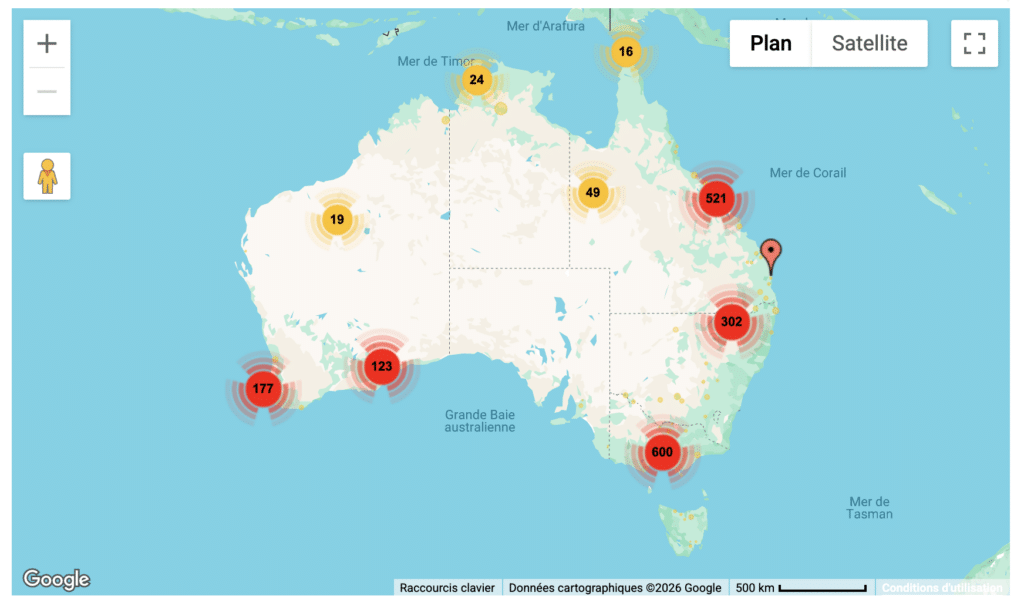
Are you looking for a fruit picking job? Access over 1,200 farm contacts for free via our interactive map.
Environmental impact
By reducing the number of vehicles on the road, ridesharing helps to decrease traffic congestion (in cities) and lower carbon emissions, contributing to a greener environment.
Social Interaction
Ridesharing offers an opportunity for social interaction, allowing you to connect, make new friends, and build a sense of community. It turns the often mundane act of commuting into a more enjoyable and engaging experience.

Ridesharing in Australia – How to get a lift
Word of Mouth
It’s simple: Just ask other people if they have a spare seat to offer! Whether you are sharing a room or a hostel, don’t hesitate to talk about it around you if you are looking for or offering a lift. Ask around, don’t hesitate to talk about your travel plans. You can also post an ad in a youth hostel or on websites like Gumtree.
Facebook groups
This is where most rideshares are arranged in practice, faster than any website, because people post and reply within minutes. Two worth joining:
- Backpacker & Travellers Rideshare in Australia: the largest backpacker-focused group, linked to CoSeats.
- Rideshare and Carpool Australia: general-purpose, active on long interstate routes.
Beyond those, search Facebook for your route or region plus rideshare or backpackers, most cities and popular corridors have their own group, and the regional ones are often better for farm work areas.
Rideshare websites
A handful of platforms cover Australia specifically. These are the ones backpackers actually use:
- CoSeats: the main rideshare network in Australia and the first place to look. You post a trip or search for one, see driver and passenger profiles before committing, and agree the cost up front. Built around interstate travel rather than commuting, which is exactly what you need.
- Gumtree — Rideshare & Travel Partners: an entire classifieds section dedicated to lifts. Less polished than a proper app and there’s no rating system, but it’s busy and free. Filter by state and check daily: good offers go within hours.
- ShareYourRide — smaller, but worth a look if the others come up empty on your route.
If you’re coming from Europe: BlaBlaCar does not operate in Australia. You’ll find Facebook groups using the name, but the platform itself isn’t here. CoSeats is the closest equivalent.
🚐 The trick most people miss: campervan relocations
Rental companies constantly need vehicles moved back between depots, and they release them for a nominal daily rate — often around $1 a day, sometimes with fuel included. You get a campervan, which doubles as your accommodation, for close to nothing. The catch is fixed dates and a tight deadline, so it only works if your plans are flexible. CoSeats lists these alongside rideshares.
Car Sharing in Australia: pros and cons
Pros
- Convenient and reliable mode of transport, particularly in areas with limited public transport options when you don’t have a car.
- It’s cheap for the owner of the car as well as for the one who gets a lift.
- Make friends on the way
- Improve your English if you’re not a native speaker.
Cons
- No or little privacy
- Risk of disagreement in the group
- Less freedom …
- It’s important to take safety precautions (share your travel plans with friends or family, meet in public places, etc). See below for more info.

Staying safe
You’re getting into a car with a stranger, often for several days, in places with no phone signal. That’s fine, thousands of backpackers do it every year without incident but a few habits make the difference.
- Talk before you commit. A phone or video call tells you more in five minutes than fifty messages. If something feels off, don’t go, there’ll be another lift.
- Meet in a public place and see the car before you load your bag into it.
- Send someone your plan: the driver’s name, their number, the registration plate, the route and when you expect to arrive. A photo of the numberplate sent to a friend costs nothing.
- Check the car is registered. An unregistered vehicle means no compulsory third-party insurance, which means no cover for you if there’s a crash.
- Keep your valuables on you, not in the boot, and keep enough cash to get yourself out of a situation.
- Never accept a lift in exchange for anything other than money. Any offer framed as free accommodation, work or a favour deserves an immediate no.
If you’re driving and taking passengers, the same applies in reverse and check your insurance: carrying passengers and sharing fuel costs is fine, but charging a profit can be treated as commercial use and void your cover.