














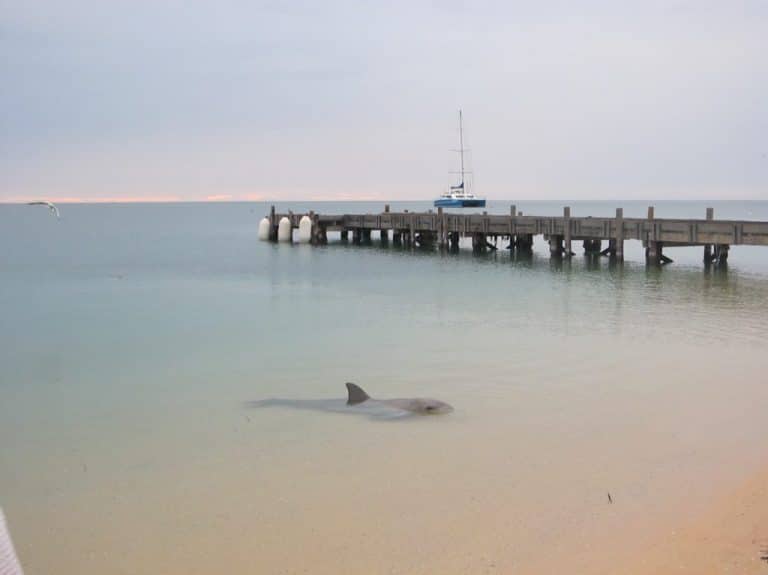
Who hasn’t dreamed of spending their mornings standing in the shallows beside wild dolphins? Back home, Marina works in water quality protection. She took a six-month sabbatical, flew to Australia, and ended up volunteering at the Shark Bay reserve in Monkey Mia — weighing fish, briefing tourists and helping rangers run one of the longest-running wild dolphin programs in the world. Here’s how it works, and how to get a place yourself.
Table of Contents
Getting to Monkey Mia
This is the part most people underestimate. Monkey Mia sits in Shark Bay, roughly 850 km north of Perth, a full two-day drive, or a long one if you push it. The turn-off from the North West Coastal Highway adds another 150 km each way, so it is emphatically not somewhere you pass through by accident. There’s no train, and bus services are limited and slow.
In practice, almost everyone who volunteers here arrives with their own vehicle. It also solves your accommodation problem, since the campground is right beside the reserve. The roads are sealed the whole way, no 4WD needed.
🚐 Get yourself a vehicle
Compare campervan and motorhome rates across Western Australia, or buy your own if you’re staying a while — our readers get 5% off at Travellers Autobarn.
Volunteer to Work with Dolphins in Monkey Mia
Located on the west coast of Australia, Monkey Mia in Shark Bay is a city renowned worldwide for its dolphins. Originally, it was the fishermen of the bay who used to feed the dolphins with fish scraps. Since the 1960s, they continue to come nibble on small fish on the beach! It is important to note that this experience is regulated, and the dolphins do not receive more than 10% of their daily intake. They are therefore completely free, and this is done to preserve their natural instinct.
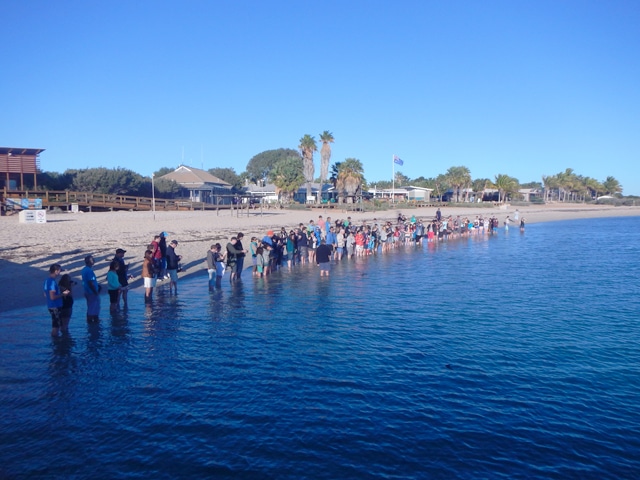
Volunteering involves assisting the rangers of the Monkey Mia reserve during the “dolphin experience” in preparing fish and feeding the dolphins that come to the edge of the beach.
Volunteers must arrive the day before their first day to undergo an “induction” which lasts 1 to 1.5 hours. The ranger explains the tasks to be performed during the morning. The days start at 7:30 am and end around 12 pm. This depends on the dolphins, as they are wild and come at their own will.
This job is obviously unpaid, and you have to manage your accommodation. The Monkey Mia Dolphin Resort campsite is located right next door. You won’t have to pay the reserve entrance fee ($15 per person). In the morning, tea, coffee, and some food are available to volunteers in the fish room.
Do it because you want the experience, not because you think it counts. Two weeks at Monkey Mia is a genuinely rare thing to have done — just budget for it as time off rather than time banked. If you’re weighing up unpaid work more broadly, our guide to volunteering in Australia covers what’s worth your time.
How to Become a Volunteer in Australia?
Monkey Mia
Overview: One of the world’s oldest dolphin-interaction sites, famous for its daily wild feeding sessions.
You have the opportunity to volunteer at Monkey Mia by contacting the reserve. It’s possible to volunteer there for a few days or even weeks. To apply, you can go directly to the site and speak with the store employees, or call them at (08) 9948 1366.
You can also email them at monkeymiavolunteers@dbca.wa.gov.au, including your availability, past experiences, a bit about yourself, your motivations, etc.
What You Do:
- Observe wild bottlenose dolphins that visit the shore each morning.
- Assist rangers with data-collection: record pod sizes, individual IDs, and feeding behaviour.
- Educate other visitors about dolphin biology and conservation.
Port Stephens Dolphin Ecology Program (New South Wales)
- Overview: Port Stephens is home to resident bottlenose dolphins and a world-class research centre.
- What You Do:
- Swim in regulated groups under expert supervision of marine biologists.
- Conduct photo-ID surveys and behavioural watches aboard research vessels.
- Enter data into global databases (e.g. Australian Museum DolphinWatch).
- Duration & Cost:
- One-day research assistant: AUD 200 (includes boat trip, all gear, and certification).
- Multi-day internships (1–4 weeks): from AUD 1,200/week (accommodation, training, and meals).
Magnetic Island Marine Research (Queensland)
- Overview: Situated off Townsville, Magnetic Island hosts a small but well-studied dolphin population.
- What You Do:
- Participate in snorkel-based surveys to estimate pod health and distribution.
- Help set up and maintain GoPro camera-traps for remote site monitoring.
- Aid in sea-turtle tagging and habitat restoration alongside dolphin work.
- Duration & Cost: 5-day volunteer program: from AUD 850 (dormitory accommodation, meals, and training).
Adelaide Dolphin Sanctuary Volunteers (South Australia)
- Overview: Unique urban sanctuary protecting Indo-Pacific bottlenose dolphins in the Port River.
- What You Do:
- Join weekly kayak surveys to monitor dolphin sightings and behaviour in shipping channels.
- Conduct land-based photo-ID and litter-pickup operations along riverbanks.
- Assist in community outreach: school visits and public talks.
- Duration & Cost: Single-day volunteer session: free (kayak hire included), donations welcome.
Where to stay
Volunteers arrange and pay for their own accommodation. The Monkey Mia Dolphin Resort campground is the obvious choice — it’s a two-minute walk from the beach where the feeding happens, which matters when your day starts at 7:30am. It’s also effectively the only option at Monkey Mia itself.
The alternative is Denham, 25 km away, the nearest town and a cheaper base if you’re staying more than a few days. Either way, book ahead: Shark Bay is busiest between April and October, and there is nothing else within 150 km.
Places to stay in Shark Bay
Check what’s available at Monkey Mia and in Denham for your dates.
Working with dolphins: Marina’s lifelong dream
“Before coming to Australia, I had already heard about Shark Bay. Since I was a child, dolphins have fascinated me. I’ve read dozens of books about the sly sea creatures. One of them was about a scientist watching the social behaviour of dolphins in Monkey Mia. So I decided to go to Monkey Mia one day. And it happened. Two months before flying to Australia, I emailed the Shark Bay Reserve and asked if I could volunteer there. I received the answer not long after.
My daily tasks
One day prior to starting the job, we had to go in for an introduction, which lasted about an hour. One of the staff members explained to us the tasks we had to do in the morning. Work was from 7:30 to 12 o’clock.
We were four volunteers altogether. We opened the office, did a bit of cleaning, opened the beach, and answered tourists’ questions.
One of my favourite jobs was to assist permanent employees with the so-called “Dolphin Experience”. This included preparing food and feeding fish to the dolphins that came to the beach.
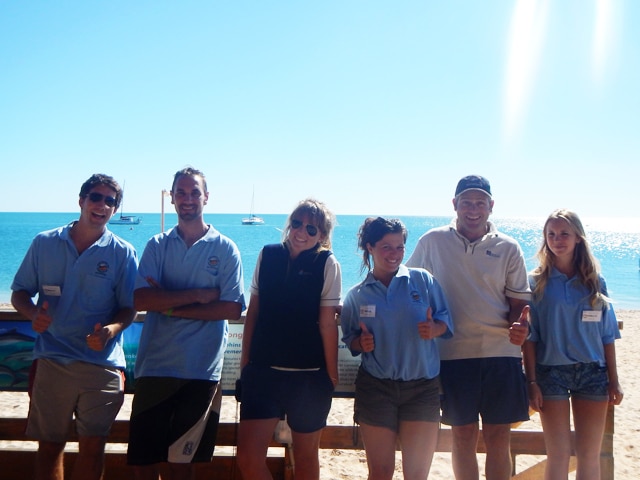
Feeding the dolphins
When the dolphins arrived at the beach, we had 25 minutes to prepare the fish. The amount of fish had to be weighed for each dolphin individually.
Then the feeding started. The permanent workers told tourists the story about Monkey Mia – while we chose people to feed the dolphins. We repeated this procedure three times in the morning. The feeding stopped at 12 o’clock.
It all started when a fisherman fed dolphins with fish leftovers. It is important to mention that the feeding is controlled and dolphins receive only 10 per cent of their daily intake from the reserve. They can move freely and listen to their natural instincts.
Fun Fact: When pelicans approached the feeding, we fed them with fish so they would not disturb the dolphins.
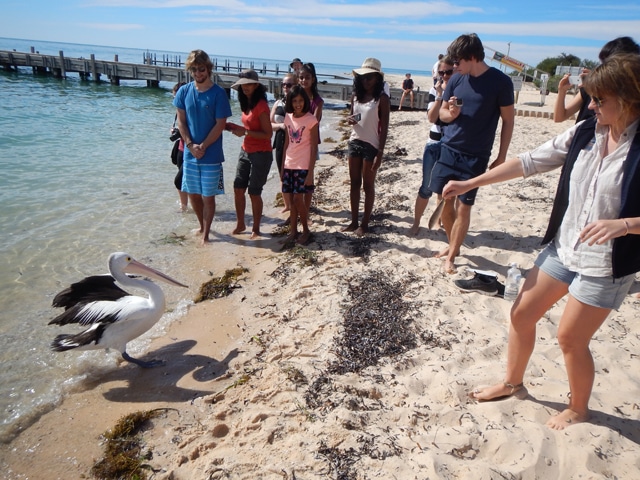
After feeding we entered all data in a list: The number of dolphins spotted, the time, their condition, etc.
At the end, we showed tourists a short video and looked at the boats in the marina, from where we could observe dolphins with binoculars.
One practical thing before you go. Shark Bay is classified as very remote — the nearest hospital is in Carnarvon, over 300 km away, and anything serious means a flight. Check that your policy covers volunteer and manual work, which plenty of standard travel insurers exclude by default. Our readers get 10% off Go Walkabout cover, and our Working Holiday insurance guide explains what to look for.
Benefits of working with dolphins
Apart from fulfilling my lifelong dream, there were no financial benefits. But that didn’t bother me. The work was voluntary and I had a lot of fun. There was an affordable campsite next to the Shark Bay Reserve: Monkey Mia Dolphin Resort. The entrance to the Shark Bay Reserve was obviously free. Volunteers also get tea, coffee, and sweet treats.
Working with dolphins was a great experience. Unfortunately I could not stay longer than 15 days (that was the maximum for volunteers). But I enjoyed every day.
- Facebook page: Monkey Mia Dolphin Experience
- Internet website: www.monkeymia.com.au
- Mail : monkeymiavolunteers@westnet.com.au