















To extend your stay in Australia with a second-year visa (subclass 417 or 462), you generally need to complete 88 days of specified work in an eligible regional area — jobs in agriculture, forestry, fishing, mining, construction, tourism and hospitality. Getting the count right is essential to meet the visa requirements and plan your time. Here’s everything you need to know — plus a free calculator to work out your days.
🇬🇧 UK passport holders, good news: Since 1 July 2024, you no longer need to complete the 88 days (or the 179 days for a third visa) to apply for your second or third Working Holiday Visa. See the UK section below.
Table of Contents
Free 88-day calculator
Use our free calculator to estimate how many days of specified work you’ve completed and how many you have left:
Add a pay period
Recorded payslips
How Immigration counts your days
Based on the official example Maria: 6 h/day × 5 days = full-time
Australian legal full-time standard
| Situation | Days credited |
| Farm · 40 h/week (full-time) | 7 days |
| Farm · 20 h/week (half-time) | ~4.7 days |
| Construction · 40 h/week | 7 days |
| Construction · 30 h/week | 5.5 days |
| Piecework · 5 days worked | 7 days |
How to Qualify for a Second-Year Working Holiday Visa in Australia
Just like your first Working Holiday Visa, you must meet specific conditions to qualify for a second-year visa:
- Age requirement: You must be between 18 and 35 years old for most eligible countries. (The age limit was raised to 35 for the UK, Ireland, France, Italy, Denmark and Canada, and since 1 July 2026, also for Germany, Cyprus, Finland and South Korea. For some other nationalities the limit is still 30 — check your country on immi.homeaffairs.gov.au.)
- Valid passport: Your passport must be valid at the time of application.
- Completed regional work: You must have worked at least 3 months (88 days) of eligible specified work in a designated regional area – unless you hold a UK passport (see below).
Visa fee: The second Working Holiday Visa costs 1,000 AUD (the same as the third visa; the first visa costs 840 AUD, as of July 2026). Fees are reviewed every July — check the current amount on immi.homeaffairs.gov.au.
More information here: Apply for second year visa
Changes for UK Passport Holders
Under the Australia–UK Free Trade Agreement, the rules for British travellers have changed significantly:
🇬🇧 Since July 2023: UK passport holders can apply for a Working Holiday Visa between the ages of 18 and 35.
🇬🇧 Since 1 July 2024: UK passport holders can be granted up to three Working Holiday Visas without having to complete the 88 days of specified work (and without the 179 days normally required for a third visa). You can work or travel anywhere in Australia — no regional/farm work needed.
⚠️ Important: This exemption applies only to UK passport holders. All other nationalities (Ireland, France, Germany, Canada, etc.) still need to complete the specified work. Dual nationals: if you entered Australia on your Irish (or other) passport, you must complete the days to extend that visa — but you could apply for your next visa on your UK passport to use the exemption.
Read also : Free Trade Agreement Australia – UK

What Counts as ‘Specified Work’ for the 88 Days?
Specified work includes jobs in agriculture, forestry, fishing, mining, construction, and tourism/hospitality. The eligible industries differ depending on your visa type (417 or 462).
Industries and areas approved for Subclass 417 visa holders
- tourism and hospitality in Northern, Remote and Very Remote Australia, from 22 June 2021
- plant and animal cultivation in regional Australia
- fishing and pearling in regional Australia
- tree farming and felling in regional Australia
- mining in regional Australia
- construction in regional Australia
- bushfire recovery work in declared bushfire-affected areas, carried out after 31 July 2019
- recovery work in flood, cyclone or other severe weather-affected areas, carried out after 31 December 2021
- critical COVID-19 work in the healthcare and medical sectors, anywhere in Australia, after 31 January 2020
Industries and areas approved for Subclass 462 visa holders
- tourism and hospitality in Northern, Remote and Very Remote Australia, from 22 June 2021
- plant and animal cultivation in Northern Australia and other specified areas of regional Australia
- fishing and pearling in Northern Australia only
- tree farming and felling in Northern Australia only
- construction in Northern Australia and other specified areas of regional Australia
- bushfire recovery work in declared bushfire-affected areas, carried out after 31 July 2019
- recovery work in flood, cyclone or other severe weather-affected areas, carried out after 31 December 2021
- critical COVID-19 work in the healthcare and medical sectors, anywhere in Australia, after 31 January 2020
🧑🌾 Eligible jobs to renew WHV in Australia
Find out all eligible jobs for a second working holiday visa.
How to Accurately Calculate Your 88 Days or 3 Months of Specified Work
Understanding the minimum requirement
The 3-month period refers to the three shortest calendar months of the year — meaning you must complete at least 88 calendar days, including any rest days or weekends that fall during your employment.
You have flexibility in how you complete these days:
- One continuous period with the same employer, OR
- Multiple shorter periods with different employers in various industries.
For example, you could work one month on a farm in the Northern Territory and two months in mining in Tasmania. The work can be spread across your visa period.
Ways to Meet the Work Requirement
You can reach the 88 days / 3-month requirement through different work arrangements:
📌 Full-time, part-time, or piecework spread out over multiple short contracts, adding up to 5 days a week over 3 months.
📌 Continuous full-time work of 5 days a week for a total of 3 months (including agreements based on a piecework rate).
📌 Less than 5 days per week over a longer period, provided it reaches the equivalent of 88 days.
This flexibility allows you to tailor your work schedule to your travel plans while ensuring you meet visa requirements.
How to count a ‘day’ of specified work
A ‘day’ of specified work doesn’t necessarily mean a full 8-hour shift. A workday is any calendar day on which you perform specified work for the normal number of hours considered standard in your industry — usually 35 to 40 hours a week, or 7 to 8 hours a day.
Note: for volunteer bushfire or flood recovery work, any day on which you worked counts as one day.
Full-Time vs. Part-Time Work Calculations
✅ Full-Time Workers
- If you work 5 days a week, each day counts as 1 day toward your 88 days.
- You can count your week-ends are days worked – so it will be a total of 7 days / week.
✅ Part-Time Workers
- Your total working hours need to be equivalent to full-time hours in your industry.
- Keep track of your hours worked and divide by the industry standard (usually 35–40 hours per week) to determine your eligible workdays.
Public holidays and sick days can be counted as a day of specified work if you are paid for that day. If you are not not paid then those days cannot be included in your total period of specified work.
❌ Overtime does not count as extra days. If a normal workday is 5 hours, working 10 hours in one day still counts as only 1 day.
Casual Work & Piece Rates
If you’re working casual jobs or paid on piece rates (e.g. fruit picking), calculating your days is trickier:
🔹 Keep detailed records of hours worked each day. 🔹 Make sure your total hours add up to full-time-equivalent days. 🔹 Fair pay matters: some second-year applications have been rejected due to underpayment. Since 2022, piece-rate workers are entitled to a guaranteed minimum hourly rate.
What about the salary?
Minimum wages in Australia are set by awards (collective agreements) and vary by age and contract type (full-time, part-time or casual). Casual workers receive a higher rate — the standard casual loading is +25%.
💰 The national minimum wage is 26.44 AUD per hour (before tax), or about 1,004.90 AUD per week (38 hours), since 1 July 2026.
Your exact minimum depends on your industry: fruit and vegetable work falls under the Horticulture Award, construction under the Building and Construction General On-site Award, and so on. Check your rate — including the current piece-rate guarantee — on the Fair Work website.
Weather Conditions & Work Interruptions
⚠ Bad weather, accidents, or unexpected closures can impact your workdays.
- If you are paid for a missed workday (e.g., sick leave), it counts towards your 88 days.
- If you do not receive payment, the day does not count.
Keeping accurate timesheets, payslips, and employer documentation is crucial to ensure your workdays are properly counted for your visa renewal.

Documentation
Pay slips: keep them all — they must show your employer’s ABN and your work details.
Work diary: record daily tasks, hours and breaks.
Employer sign-off: have your employer confirm your completed days periodically.
Calculate your 88 days — examples
Examples extracted from the immigration website
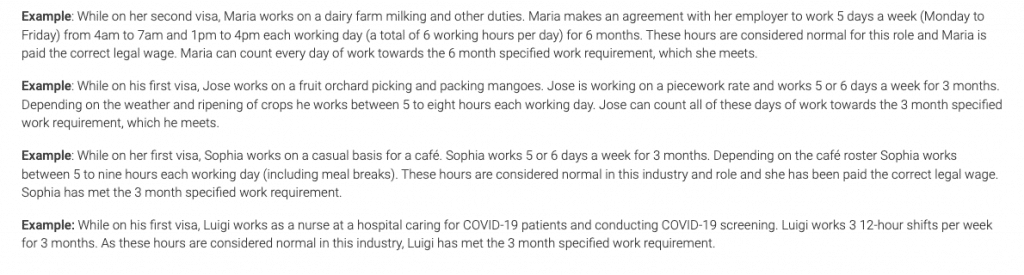
Examples where the requirement IS met
Work during the week — 3 months on a farm, 5 days a week (industry standard = 5 days): weekends count, so 7 days a week.
Shift work — 3 months on an irregular roster (e.g. 1 week on, 1 week off): counts as 3 months.
Illness — 3 months full-time with paid sick leave: counts as 3 months.
Different employers — 60 days as a harvest helper + 28 days as a construction worker = 88 days.
Examples where the requirement is NOT met
Work during the week — 3 months on a farm, only 4 days a week (industry standard = 5): weekends don’t count, so only 4 days/week.
Working on another visa — you can only apply for the second-year visa if the work was done on a Working Holiday Visa. Farm work done on a student visa doesn’t count.
Seasonal circumstances — if you’ve accumulated only 80 days and can’t finish the last 8 before your visa expires (e.g. due to bad weather), you can’t apply.
Applying for the Visa
Once you have completed your days:
- Proof of Work: Gather all documentation, including pay slips, work diaries, and any signed forms from your employer.
- Application: Apply online through the Australian Government’s Department of Home Affairs website, providing all necessary documents.
Apply for a Third year working holiday visa
A third year is possible. You need to complete 6 months (179 days) of specified work in regional areas while on your second WHV (417 or 462). The eligible jobs and regions are the same as for the second visa, and the work must have been done after July 2019.
🇬🇧 UK passport holders are exempt from this requirement too (since 1 July 2024).
Fee: the third WHV also costs 1,000 AUD.
In Conclusion
Check that both the job and the geographic area are eligible. Confirm your status when you sign your Tax File Number Declaration at the start of each job, as this affects your day count. If you’re employed casually, count only the days actually worked to be safe. If you spread your 88 days across several jobs, keep a running total so you don’t get any nasty surprises.
Each case is unique, and the final decision always rests with an immigration officer so keep all your documents (payslips, photos, bank statements, etc.).
FAQs
Specified work includes jobs in agriculture, forestry, fishing, mining, and construction. The Australian Government provides a detailed list of eligible roles and areas where this work can be undertaken.
The 88 days can include weekends if you have worked the standard five days in the week. Part-time work can count, but the days are calculated based on a standard full-time workday. Irregular or casual work may require a more detailed calculation.
Yes, you can work for multiple employers to accumulate your 88 days. The key is to ensure that all work is eligible and properly documented.
You will need payslips, bank statements showing pay, and employment references or contracts. Keeping a detailed work diary is also recommended.
The main difference lies in the types of work and locations that are eligible. Subclass 417 and 462 have different specified work requirements, which are detailed on our website and the official website.
Article updated on 08/09/2026








Hello
I’m planning to move to Australia in july and i already got my visa granted. i have one question. I’m planning to work on mining/fifo but i not sure about the 88 days that i need to work to apply for my 2nd visa. If I work in 2/1 roster (2 weeks working and 1 off), does the week off count for the 88 days?
Hi Fabio, yes it will count. Cheers
Hello
I want to prepare soon my application for my second year WHV. Therefor I have troubles with counting my 88 days.
In my first WHV in 2020 I worked 83 days regular hourly work.
Additionally I worked 8 days in total where I worked on a blueberry farm and got paid per piece rate
(4, 8, 7, 1, 9, 6, 12, 8 Buckets on each day)
how do I count those days ?
Hi there, just count one day per day worked – so 8 days in total.
Hey there!
I already did 5 weeks in a dairy farm, but in one of the 5 weeks I worked only 32 hours.
Same thing now, I’m doing hospitality in a remote area and some weeks I work only 36 hours.
My question is: how much days should I count for the weeks that I have not reached the 35/38 hours?
Cheers
Hi there, I believe you can count 7 days for each job. Cheers
Hi there, I’m working as a disability support worker in an eligible post code in WA does this count towards my 88 days?
Hi Nicole, don’t think it will count sorry. Better check with the immi directly though. Thx
Hi there! I’m working in Darwin to complete my 88 days and found a job working with a catering equipment company. The thing is, it’s an admin job dealing with the accounts/reception work. Do you know if this particular job would count towards the 88days? It’s technically in the approved sector of “catering services” but not sure if the job itself counts because it’s admin.
Thanks a bunch 🙂
Hi Sam, could work but will depend on your title on your payslips – or the list of your missions. Cheers
Hi there, I’m not sure how exactly i should calculate my days for the second year of visa.
I work in a farm as farmhand with a casual contract under the horticultural award.
I get to work 5 days a week, Monday to Friday, each day I work 7/8 hours or more it depends, but some days I’ll work less, around 5/6. I get a total of 35 hours per week or more, my questions are
Can I count a full week ( 7 days ) if I work at least 5 days 7h per day?
If I work a total of 35 h or more in a week over 5 days, but one of these days I get to work less than 7h let’s say 5/6h does it count as a day? Therefore can I count a full week even if one of the days worked was less than 7h?
Should I just count the hours worked in a week or the hours worked each day?
I don’t want to end up doing 5 months instead of 3 because 1 day a week I work less than 7h and i can’t count a full week of work for that.
Thanks for any clarification!
Cheers
Hi ! My name is Amelie , I am now doing my 6 month work for my 3 rd year of visa .
I am working as a traffic controller in Sunshine Coast!
I have a question regarding on how to count . I get my payslip every week.
It’s a casual contract and lot of weeks I do 57 hour but sometimes I have a week of 26 hours or less .
Can I use some of those 57 hour on my 26 hour week ? So it can be counted as 7 days ?
Hi Amelie, yes you should 🙂 Cheers
Hi I am working as an accountant for tourism and hospitality in a regional code area. does this count as my 88 days.? thanks
Hi Debra, I don’t think it sill unless you are in contact with customers ?
Hey there,
thanks a lot for all the information!
I’m right now applying for my 2nd year visa and I’m unsure what to fill in for the total days worked. In the explanation they say “Provide the total number of days actually worked, including leave days for which you were paid.”
Which is quite confusing now.
I got payed for 38 hours each week for 13 weeks in total plus extra 2 days before and 6 days afterwards.
So do I calculate the days for the 38 hours/ counting as 7 days or for the actual 5 days per week that I worked?
Because if I calculate for the 5 days it’ll be less than 88 days and if I calculate for 38h/7 days it’ll be around 100.
If you have any idea, also where to look it up, I’d be super grateful:)
Hi there,
38 hours will count as 7 days 🙂 so you should be good to go 🙂
Hello!
Five years ago, I worked as a blackberry picker in Tasmania Costa inc. At that time I worded on contract rate. So the number of hours worked is not specified on my payslip. Instead of hour, Base hour of 38 is specified. I have a total of 13 payslips. But Two payslips worked for only one or two days. Because of weather issue. I would like to know if such payslip that include short-term work can be considered as valid payslip when applying for the Second Working Holiday Visa.
Thank you!
Hi Young, yes all payslips are considered when applying for a renewal. Cheers
Hello,
I have a specific questions regarding the 88 days & leave days due to illness (WorkCover).
I do know that quote from the government’s website “Australian public holidays and sick days (or equivalent worker’s compensation leave days) can be counted as a day of specified work if you are paid for that day.” but I’d like to get a confirmation from you since you seem to know very well about that subject.
I am working on a farm in order to get my 88 days sorted. I injured my hand and I have been receiving compensations from my employer’s insurance: 1045$ gross per week which represents 36h of work since my hourly is 28.5$. I am receiving payslips where we can see I have a compensation but 0 hours worked obviously. Can I count 7 days for the 88 days per compensated week ?
Thanks a lot,
Cheers Matt
Hi Matt, yes you should be able to count those days as you are receiving payments from your employer under Workers comp. Cheers
Ok thanks!
Hi! I have a question about the way my employer pays me. Is it ok to sign off 88 days if they pay me through ABN but not TFN?
Thanks
Hi! I’m wondering if my farm work still can be counted for 88 days by being paid through ABN not TFN? Thanks
Hi A, no dont think this will work 🙁
Hi I work casual in hospitality and some weeks I do 34/35h and some weeks 38h. Can I still count every week as a full 7 day work week or only the ones where I did strictly over 38h?
Hi Betty, hard to tell but yes it should be fine. Cheers
Hello,
I work casual in hospitality and the industry standard says 38h a week. My hours fluctuate depending on how busy it is. Sometimes I do 30 hours and sometimes I do 40 hours. But in average it’s about 35 hours a week.
I work 6 days a week but the shifts are quite short (4-6 hours), but in my payslip, you can only see the total hours worked, not the days. Can I count those 30-hour weeks as 7 days instead of 5, given the fact that on average i work around 35h a week, even though the industry standard is 38?
Hi Lis, yes this should be fine to count it as 7 days. Cheers
Hi, I’ve been working a 2&1 swing 12 hour shifts on a mine in regional WA, will my scheduled weeks off count towards my 88 days? Cheers
Hi Joe, yes it should. Cheers
Hello everyone ! I’m currently on a WHV 417, and working hospitality in regional Australia in a restaurent. Unfortunatly they can only offer me 25 hours of work/week, so i found a 2nd job in a fast food in order to get over 35h of work per week. Does combining the hours of 2 jobs with over 35h/week will count as 7 days of eligible work in a week ? Thanks in advance !
Hi Sann, yes you could do that 🙂
Hi!
My partner and I are both British and are set to arrive in Aus in November, both on working holiday visas.
To get our second year visa, will we need to complete the 88 days? Or will we simply qualify for the 2nd year without the 88 days because we will be reapplying after July 2024?
Thanks so much!
Eve
Hi Eve, in theory you will be able to apply for a second year without the need to do the 88 days from 1st July 2024. Cheers
Hi I’ve did 13 weeks regional work and in every week I’ve did more than 40 hours each week, I’m a plumber doing plumbing work in regional areas, would I have completed my 88 days by now? Does doing more than 38 hours a week count as 7 days? Thanks
Hi Ross, yes it will count as a full week (7days). Cheers
Hi there,
I wanted to ask if a labourer on a poultry farm would qualify towards my 88 days? Even with the info on the website it can be so confusing! Cheers in advance!
Hi Luke, yes it should be eligible as long as the postcode is too. Cheers
Hi,
My partner and I (both Brits) arrived in Australia at the end of February and we are currently doing our 88 days in rural WA, which will be completed by the end of November 2023. Under the new agreement will we still have to complete a 6 month stint next year to qualify for the 3rd year visa?
Hi DW, from 1st July 2024, you wont need to. Cheers
Hi Guys,
Any idea if working as a First Aid instructor in a regional area would be counted? It’s on the job shortage list but I don’t have the required amount of experience to be sponsored just yet
Hi Hannah, I do not think it could be counted but I would recommend you contact the immi to be sure. Cheers
Hi bestie
I read comments but there were too many so I am not sure if this question is asked yet,
But I worked 3.5hours as a trial for one day last week.
can I count it as one day out of 179 days?
Or it’s just nothing cause it’s not 7 hours.
Or do I need to do (179*24hours-3.5hours) calculation in this situation?
I am asking this cause I have exactly 6.5 months left to start my 88 days so I am desperate
Hi Rin, don’t think you will be able to count the trial. You need to do at least 30hours per week (depending on the industry) to be able to count a full week (7 days). Cheers
Hello,i work in a abattoir 5 days per week,i work sometime 30 h per week,is that count 7 days?
Hi Charles, depends on average hours in the industry – but i ll be tempted to say yes. Cheers
Hello,
I work casual on contract. The contract is very abstract. It does not say exactly how many hours a week I will work at least (only that it will be maximum 38 h per week) and until when my contract goes (9-12 weeks).
There are 3 different shifts a day. My employer sometimes gives me shifts 4 hours a day (one shift) and sometimes 3 shifts a day (11.5 hours).
This week they only wanted to give me 4 work days in which I am employed for a total of 38 hours. Would this week still count as a full work week or do I absolutely have to work 5 days a week?
Thanks in advance for the answer!
P.S. I work in hospitality in Darwin.
Hi Ana, if you did 38hrs then it will count as a full week. Cheers