














Australia is home to world‑ranked universities, cutting‑edge research and a multicultural campus life. Here’s everything international students need to know—from visas and tuition to work rights, living costs and post‑study pathways.
Table of Contents
Which Visa Options to study in Australia?
If you want to study in Australia, you have 3 visa options:
- A Visitor/ Tourist Visa allows you to study for a maximum period of three months (choice of courses: full time, part time …)
- A Working Holiday Visa allows you to study for a maximum of four months (choice of courses: full time, part time …)
- The Student Visa is what you need if the two previous options do not suit you. This visa allows you to study the course of your choice for as long as you wish. It also gives you the right to work during your studies.
Student Visa (subclass 500)
The Student Visa allows you to study:
- Vocational Education and Training (VET) courses –a registered VET course or a registered course for the award of an advanced diploma
- Higher education courses
- English Language Intensive Courses for Overseas Students (ELICOS)
- Postgraduate Research degrees
- Secondary school exchange program.
Other visas for specific situations
- Student Guardian visa (subclass 590) — to accompany and care for a student under 18.
- Training visa (subclass 407) — for structured workplace-based training. This replaced the old subclass 402, which no longer exists.
- Temporary Graduate visa (subclass 485) — to stay and work in Australia after finishing your studies.

⚠️ Recent changes worth knowing
• Genuine Student (GS) requirement — since 23 March 2024 this has replaced the old GTE. You now answer structured questions in the application form, around 150 words each, rather than writing a free-form essay. Crucially, the GS accepts that you may later seek permanent residence, provided study is your genuine primary purpose.
• Enrolment caps — institutions now operate under limits on new international enrolments. Check your institution’s intake position before committing.
🚨 New rule (2 October 2026): you can no longer apply for a Student visa from within Australia on a WHV
Since 2 October 2026, holders of a Working Holiday visa (subclass 417/462) — along with Visitor (600) and Temporary Graduate (485) visa holders, among others — can no longer lodge a Student visa (subclass 500) application while in Australia. Studying after your WHV is still possible, but you must now apply from outside Australia (and be offshore when the visa is granted). Plan ahead: finish your WHV, leave the country, then apply from home. (Source: Department of Home Affairs — Migration Amendment (Student Visa Reform) Regulations 2026. Always check your situation on immi.homeaffairs.gov.au.)
Eligibility & Conditions
Step 1: Enrol in an Australian school / institution
To get your Student Visa you have to be accepted by an Australian institution CRICOS accredited (Commonwealth Register of Institutions and Courses for Overseas Students). The course duration should exceed three months.
The first step is therefore to decide which studies you want to do and at which institution. The choice of city is also important for the choice of institution. This could be a university, a language school or a vocational training centre (TAFE).
If you are not in Australia to apply, check the school’s website. All university websites have a section for international students. This is where you will find the procedure for applying. You will need to attach various documents to your application (passport, transcript of records, diplomas obtained).
Once you have completed your application form, all you have to do is wait for the school to reply. If you receive a letter of acceptance, you will have to reply and pay the first semester’s registration fee. You will then receive the Overseas Student Confirmation of Enrolment (CoE). The number given in this confirmation is required to apply for your student visa (step 2).
Note: You may have to prove your English language proficiency (entry requirements vary according to your level of English, the course you want to study and between the institutions). It is therefore necessary to register for a session in advance and to prepare for it.
Step 2: Apply for your Student Visa
Once you have obtained your COE (Confirmation of Enrolment) from your chosen Australian institution, you can apply for your student visa.
To apply for a student visa, you need to do it online on the Australian Immigration website.
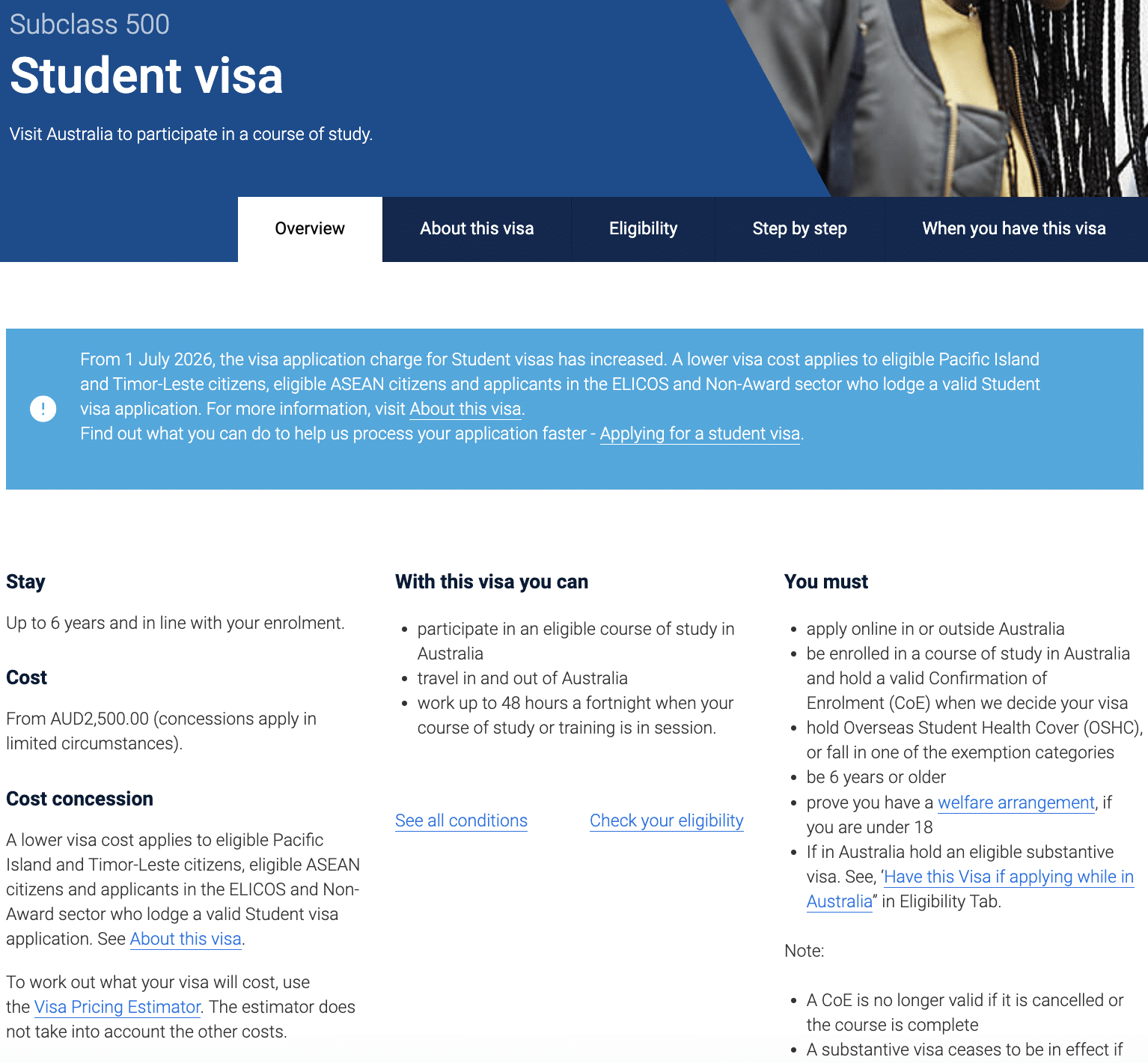
Select the Subclass 500 Visa and complete the application form (approximately 30 minutes).
You will need to attach documents (passport, English test results (if applicable), translated transcripts (if not in English)). Prepare these documents before you start your application. Once the application is finalised, you will receive a Transaction Reference Number to track the progress of your application.
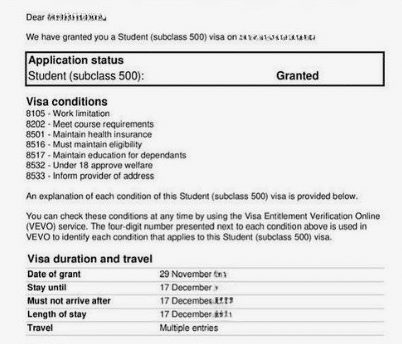
When your application is successful, you will receive a Notification of Grant Letter by email. Don’t delete it. It is your official visa.
Please note that you must have OSHC (Overseas Student Health Cover) for the duration of your studies.
How much does the student visa cost?
- Application charge: AUD 2,500 for the main applicant, since 1 July 2026. A lower rate of AUD 2,050 applies to ELICOS and non-award courses.
- Non-refundable, including if your application is refused.
- Valid for up to 5 years, aligned with the length of your enrolment.
- You can enter Australia up to 90 days before your course starts.
The visa fee is only part of what you need to show. You must also demonstrate access to around AUD 29,710 per year in living costs, on top of tuition and your return airfare. This figure is reviewed annually — check the current amount before you apply, because underestimating it is one of the most common reasons applications fail.
Processing times vary considerably by country and course level. Check the current estimate on the Home Affairs website rather than relying on any figure you read elsewhere, including this one.
🏥 OSHC: sort this before you apply
Overseas Student Health Cover is a condition of the visa, and it has to cover your entire stay. Your visa length is tied to your policy length — a policy that’s too short shortens your visa. It also has to be in place before you lodge the application, not after.
What does a student visa allow?
The subclass 500 allows you to stay in Australia to study full-time in a recognised education institution. You have to study for a minimum period of three months (full time course). The advantage of the Student Visa is that it allows you to work 48 hours per fortnight (two-week period) during your course and without limitation during holidays. It is a good way to finance your studies or simply to put money aside.
You can study the course of your choice, at the university or school you choose. During your visa period, you can enter and leave the country as you wish. So you can decide to travel to other countries during your holidays!
If you have a partner and if you can proof that you’re in a relationship for more than 1 year, your partner can join your Student Visa for free and work part-time without having to study (same for family members). There is an additional cost to add an applicant on your visa. And apply online in or outside Australia.

How does studying in Australia work?
In Australia, students start their academic year either in February or in July for universities and vocational schools. As far as language courses are concerned, they start every two months or so.
The Australian education system is relaxed and the teachers are accessible. You can easily ask them questions or chat with them after class. Teachers encourage students to participate in debates and discussions during class.
As far as timetables are concerned, in Australia, students generally study four subjects per semester, which represents about ten hours of classes per week. However, you should know that personal work is important.
These light schedules allow students to have a job to finance their studies. Indeed, you can work 48 hours/2 weeks outside the school holidays.
How much does it cost to study in Australia?
Tuition fees
Studying in Australia comes at a price. Australian universities are world-renowned and studying there represents a real investment. In addition to the cost of student life, tuition fees at Australian universities are very high.
| Level | Cost (A$) / year |
|---|---|
| Bachelor’s degree | From A$20,000 – 50,000 |
| Master’s degree | From A$22,000 – 54,000 |
| Doctorate (PhD) | From A$20,000 – 42,000 |
If you want to do a vocational course (TAFE), the fees will be around $10,000 per academic year (less for some courses).
Finally, for language courses, marketing or business schools, the fees are lower, at around $2,500 per term.
Visa application fees
The school or university registration fee does not include the visa fee. So, in addition to the amount you pay at the time of enrolment, you will also have to pay the student visa application fee, from $2500 (July 2026).
Health insurance costs
To study in Australia, you must have health insurance for the duration of your student visa. This insurance, called Overseas Student Health Cover, is compulsory and costs around $450 per year. It provides you with the minimum level of health cover in Australia. It is therefore also advisable to take out student insurance for optimum health cover.
Read also : International Health Insurance for student
Cost of Living
| Expense | Weekly Cost (A$) |
|---|---|
| Shared rent (1 bed) | approx. 350 |
| Groceries & utilities | 100–150 |
| Transport (student cap) | 20–40 |
| Mobile & internet | approx. 20 |
| Entertainment & misc. | 50–80 |
Expect A$700–1,000/week in Sydney/Melbourne; regional cities can be ~ 15% cheaper.
Which city should I choose to study in Australia?
Sydney
Home to over 200,000 students and the largest concentration of universities in the country:
- University of Sydney — Group of Eight
- UNSW Sydney — Group of Eight, currently Australia’s top-ranked university
- Macquarie University
- University of Technology Sydney (UTS)
- Western Sydney University
- Australian Catholic University
- University of Notre Dame Australia
Around 80 km south, the University of Wollongong is well connected by train and considerably cheaper to live near.
Melbourne
- University of Melbourne — Group of Eight
- Monash University — Group of Eight
- RMIT University
- Deakin University
- La Trobe University
- Victoria University
- Swinburne University of Technology
Brisbane
Noticeably cheaper than Sydney or Melbourne, with better weather most of the year:
- University of Queensland (UQ) — Group of Eight, the city’s most prestigious
- Queensland University of Technology (QUT)
- Griffith University
- Australian Catholic University
- James Cook University — main campuses in Townsville and Cairns, with a Brisbane campus
Nearby on the Gold Coast: Bond University and Southern Cross University. To the north, the University of the Sunshine Coast (UniSC).
Why study in Australia?
Australia is a country offering an exceptional lifestyle with sunshine, dream beaches and good humour. What’s more, the country’s education system is one of the best in the world. The quality of its education is recognised worldwide with Top‑Tier Institutions: 8 universities in the global top 100. This will offer you many professional opportunities. Studying in Australia also gives you the chance to move abroad afterwards. Employers will appreciate the fact that you have studied in the country, proving your level of English and local knowledge.
Studying in Australia is also an excellent way of improving your English if it is not your mother tongue. You’ll meet lots of young people your own age from many different countries. During your school holidays, you can take the opportunity to travel and discover this magnificent country.
Post-study work options
Temporary Graduate visa (subclass 485)
The main route to staying on after your degree. Two streams:
- Post-Higher Education Work stream for graduates of Australian universities. Duration depends on your qualification: around 2 years for a Bachelor’s, 3 for a Master’s by coursework or research, and 4 for a PhD. Longer periods apply to graduates of regional institutions.
- Post-Vocational Education Work stream for graduates of eligible VET and TAFE qualifications in occupations on the relevant skills list.
Two conditions catch people out. There is an age limit on the 485, currently 35 for most applicants, with exemptions for Hong Kong and British National (Overseas) passport holders and for PhD graduates. And you generally need to apply within six months of your course ending. Check both against your own situation early, not in your final semester.
Skilled migration
With Australian qualifications and local work experience, the skilled visa routes open up — subclass 189 (independent), 190 (state nominated) and 491 (regional). These are points-tested and depend on your occupation appearing on the relevant skills list.
Read also: how to migrate to Australia
FAQs
🎓 What are the best universities in Australia?
The best universities in Australia include the University of Sydney, the University of Melbourne, the Australian National University (ANU) and many others. Your choice will depend on your field of study.
🏡 How do I find accommodation in Australia as a student?
Accommodation options include halls of residence, shared accommodation and private flat rental. Universities often offer advice on accommodation. We invite you to read our dedicated article: Student accommodation in Australia.
📑 What are the admission requirements for international students?
Conditions vary from university to university but generally include academic requirements, language test scores and potentially letters of recommendation.
For more information about studying in Australia you can visit the official Australian government site for international studies:
- Australian government site for international studies (UK)
- Australian government site for international studies (USA)
Updated 18.08.2026